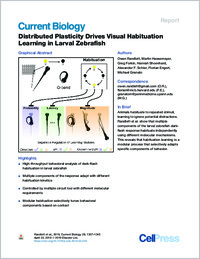
Distributed Plasticity Drives Visual Habituation Learning in Larval Zebrafish.
- Randlett O Department of Cell and Developmental Biology, University of Pennsylvania Perelman School of Medicine, Philadelphia, PA 19104, USA; Department of Molecular and Cellular Biology, Harvard University, Cambridge, MA 02138, USA. Electronic address: owen.randlett@gmail.com.
- Haesemeyer M Department of Molecular and Cellular Biology, Harvard University, Cambridge, MA 02138, USA.
- Forkin G Department of Cell and Developmental Biology, University of Pennsylvania Perelman School of Medicine, Philadelphia, PA 19104, USA.
- Shoenhard H Department of Cell and Developmental Biology, University of Pennsylvania Perelman School of Medicine, Philadelphia, PA 19104, USA.
- Schier AF Department of Molecular and Cellular Biology, Harvard University, Cambridge, MA 02138, USA; Center for Brain Science, Harvard University, Cambridge, MA 02138, USA; Broad Institute of MIT and Harvard, Cambridge, MA 02142, USA; Harvard Stem Cell Institute, Cambridge, MA 02138, USA; Biozentrum, University of Basel, 4056 Basel, Switzerland.
- Engert F Department of Molecular and Cellular Biology, Harvard University, Cambridge, MA 02138, USA; Center for Brain Science, Harvard University, Cambridge, MA 02138, USA. Electronic address: florian@mcb.harvard.edu.
- Granato M Department of Cell and Developmental Biology, University of Pennsylvania Perelman School of Medicine, Philadelphia, PA 19104, USA. Electronic address: granatom@pennmedicine.upenn.edu.
- 2019-04-09
Published in:
- Current biology : CB. - 2019
Nf1
behavior
circadian
dopamine D2 receptor
habituation
high-throughput
learning
memory
plasticity
zebrafish
Animals
Habituation, Psychophysiologic
Memory, Long-Term
Photic Stimulation
Spatial Learning
Zebrafish
English
Habituation is a simple form of learning where animals learn to reduce their responses to repeated innocuous stimuli [1]. Habituation is thought to occur via at least two temporally and molecularly distinct mechanisms, which lead to short-term memories that last for seconds to minutes and long-term memories that last for hours or longer [1, 2]. Here, we focus on long-term habituation, which, due to the extended time course, necessitates stable alterations to circuit properties [2-4]. In its simplest form, long-term habituation could result from a plasticity event at a single point in a circuit, and many studies have focused on identifying the site and underlying mechanism of plasticity [5-10]. However, it is possible that these individual sites are only one of many points in the circuit where plasticity is occurring. Indeed, studies of short-term habituation in C. elegans indicate that in this paradigm, multiple genetically separable mechanisms operate to adapt specific aspects of behavior [11-13]. Here, we use a visual assay in which larval zebrafish habituate their response to sudden reductions in illumination (dark flashes) [14, 15]. Through behavioral analyses, we find that multiple components of the dark-flash response habituate independently of one another using different molecular mechanisms. This is consistent with a modular model in which habituation originates from multiple independent processes, each adapting specific components of behavior. This may allow animals to more specifically or flexibly habituate based on stimulus context or internal states.
- Language
-
- English
- Open access status
- bronze
- Identifiers
-
- DOI 10.1016/j.cub.2019.02.039
- PMID 30955936
- Persistent URL
- https://sonar.ch/global/documents/102161
Statistics
Document views: 72
File downloads:
- Full-text: 0