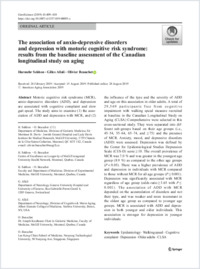
The association of anxio-depressive disorders and depression with motoric cognitive risk syndrome: results from the baseline assessment of the Canadian longitudinal study on aging.
- Sekhon H Department of Medicine, Division of Geriatric Medicine, Sir Mortimer B. Davis - Jewish General Hospital and Lady Davis Institute for Medical Research, McGill University, 3755 Chemin de la Côte-Sainte-Catherine, Montreal, QC, H3T 1E2, Canada.
- Allali G Department of Neurology, Geneva University Hospital and University of Geneva, Rue Gabrielle-Perret-Gentil 4, 1205, Geneva, Switzerland.
- Beauchet O Department of Medicine, Division of Geriatric Medicine, Sir Mortimer B. Davis - Jewish General Hospital and Lady Davis Institute for Medical Research, McGill University, 3755 Chemin de la Côte-Sainte-Catherine, Montreal, QC, H3T 1E2, Canada. olivier.beauchet@mcgill.ca.
- 2019-08-30
Published in:
- GeroScience. - 2019
CLSA
Cognitive complaint
Depression
Epidemiology
Older adults
Walking speed
Aged
Anxiety
Canada
Cognitive Dysfunction
Cross-Sectional Studies
Depression
Female
Humans
Longitudinal Studies
Male
Middle Aged
Mood Disorders
Walking Speed
English
Motoric cognitive risk syndrome (MCR), anxio-depressive disorders (ADD), and depression are associated with cognitive complaint and slow gait speed. The study aims to examine (1) the association of ADD and depression with MCR, and (2) the influence of the type and the severity of ADD and age on this association in older adults. A total of 29,569 participants free from cognitive impairment with walking speed measure recruited at baseline in the Canadian Longitudinal Study on Aging (CLSA) Comprehensive were selected in this cross-sectional study. They were separated into different sub-groups based on their age groups (i.e., 45-54, 55-64, 65-74, and ≥ 75) and the presence of MCR. Anxiety, mood, and depressive disorders (ADD) were assessed. Depression was defined by the Center for Epidemiological Studies Depression Scale (CES-D) score ≥ 10. The overall prevalence of MCR was 7.0 % and was greater in the youngest age group (8.9 %) as compared to the other age groups (P < 0.05). There was a higher prevalence of ADD and depression in individuals with MCR compared to those without MCR for all age groups (P ≤ 0.001). Depression was significantly associated with MCR regardless of age group (odds ratio ≥ 3.65 with P ≤ 0.001). The association of ADD with MCR depended on the accumulation of disorders and not their type, and was weaker and more inconstant in the oldest age group as compared to younger age groups. MCR is associated with ADD and depression in both younger and older individuals. This association is stronger for depression in younger individuals.
- Language
-
- English
- Open access status
- green
- Identifiers
-
- DOI 10.1007/s11357-019-00093-z
- PMID 31463648
- Persistent URL
- https://sonar.ch/global/documents/232755
Statistics
Document views: 44
File downloads:
- Full-text: 0