Cancer-Specific Retargeting of BAF Complexes by a Prion-like Domain.
- Boulay G Department of Pathology, Massachusetts General Hospital and Harvard Medical School, Boston, MA 02114, USA; Broad Institute of Harvard and MIT, Cambridge, MA 02142, USA; Center for Cancer Research, Massachusetts General Hospital and Harvard Medical School, Charlestown, MA 02129, USA.
- Sandoval GJ Dana-Farber Cancer Institute and Harvard Medical School, Boston, MA 02215, USA; Broad Institute of Harvard and MIT, Cambridge, MA 02142, USA.
- Riggi N Institute of Pathology, Centre Hospitalier Universitaire Vaudois, Faculty of Biology and Medicine, University of Lausanne, 1011 Lausanne, Switzerland.
- Iyer S Department of Pathology, Massachusetts General Hospital and Harvard Medical School, Boston, MA 02114, USA.
- Buisson R Center for Cancer Research, Massachusetts General Hospital and Harvard Medical School, Charlestown, MA 02129, USA.
- Naigles B Department of Pathology, Massachusetts General Hospital and Harvard Medical School, Boston, MA 02114, USA; Center for Cancer Research, Massachusetts General Hospital and Harvard Medical School, Charlestown, MA 02129, USA.
- Awad ME Department of Pathology, Massachusetts General Hospital and Harvard Medical School, Boston, MA 02114, USA; Center for Cancer Research, Massachusetts General Hospital and Harvard Medical School, Charlestown, MA 02129, USA.
- Rengarajan S Department of Pathology, Massachusetts General Hospital and Harvard Medical School, Boston, MA 02114, USA; Center for Cancer Research, Massachusetts General Hospital and Harvard Medical School, Charlestown, MA 02129, USA.
- Volorio A Department of Pathology, Massachusetts General Hospital and Harvard Medical School, Boston, MA 02114, USA; Institute of Pathology, Centre Hospitalier Universitaire Vaudois, Faculty of Biology and Medicine, University of Lausanne, 1011 Lausanne, Switzerland; Center for Cancer Research, Massachusetts General Hospital and Harvard Medical School, Charlestown, MA 02129, USA.
- McBride MJ Dana-Farber Cancer Institute and Harvard Medical School, Boston, MA 02215, USA; Broad Institute of Harvard and MIT, Cambridge, MA 02142, USA.
- Broye LC Institute of Pathology, Centre Hospitalier Universitaire Vaudois, Faculty of Biology and Medicine, University of Lausanne, 1011 Lausanne, Switzerland.
- Zou L Center for Cancer Research, Massachusetts General Hospital and Harvard Medical School, Charlestown, MA 02129, USA.
- Stamenkovic I Institute of Pathology, Centre Hospitalier Universitaire Vaudois, Faculty of Biology and Medicine, University of Lausanne, 1011 Lausanne, Switzerland.
- Kadoch C Dana-Farber Cancer Institute and Harvard Medical School, Boston, MA 02215, USA; Broad Institute of Harvard and MIT, Cambridge, MA 02142, USA. Electronic address: cigall_kadoch@dfci.harvard.edu.
- Rivera MN Department of Pathology, Massachusetts General Hospital and Harvard Medical School, Boston, MA 02114, USA; Broad Institute of Harvard and MIT, Cambridge, MA 02142, USA; Center for Cancer Research, Massachusetts General Hospital and Harvard Medical School, Charlestown, MA 02129, USA. Electronic address: mnrivera@mgh.harvard.edu.
- 2017-08-29
Published in:
- Cell. - 2017
EWS-FLI1
Ewing sarcoma
enhancers
epigenetics
intrinsically disordered proteins
mSWI/SNF (BAF) complexes
microsatellite repeats
phase transition
pioneer factor
prion-like domains
Calmodulin-Binding Proteins
Cell Line, Tumor
DNA-Binding Proteins
Humans
Mesenchymal Stem Cells
Microsatellite Repeats
Multiprotein Complexes
Nuclear Proteins
Oncogene Proteins, Fusion
Prion Proteins
Protein Domains
Proto-Oncogene Protein c-fli-1
RNA-Binding Protein EWS
RNA-Binding Proteins
Sarcoma, Ewing
English
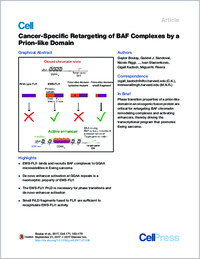
Alterations in transcriptional regulators can orchestrate oncogenic gene expression programs in cancer. Here, we show that the BRG1/BRM-associated factor (BAF) chromatin remodeling complex, which is mutated in over 20% of human tumors, interacts with EWSR1, a member of a family of proteins with prion-like domains (PrLD) that are frequent partners in oncogenic fusions with transcription factors. In Ewing sarcoma, we find that the BAF complex is recruited by the EWS-FLI1 fusion protein to tumor-specific enhancers and contributes to target gene activation. This process is a neomorphic property of EWS-FLI1 compared to wild-type FLI1 and depends on tyrosine residues that are necessary for phase transitions of the EWSR1 prion-like domain. Furthermore, fusion of short fragments of EWSR1 to FLI1 is sufficient to recapitulate BAF complex retargeting and EWS-FLI1 activities. Our studies thus demonstrate that the physical properties of prion-like domains can retarget critical chromatin regulatory complexes to establish and maintain oncogenic gene expression programs.
- Language
-
- English
- Open access status
- bronze
- Identifiers
-
- DOI 10.1016/j.cell.2017.07.036
- PMID 28844694
- Persistent URL
- https://sonar.ch/global/documents/106214
Statistics
Document views: 81
File downloads:
- Full-text: 0