Marginal Zone Formation Requires ACKR3 Expression on B Cells.
- Radice E Università della Svizzera Italiana, Faculty of Biomedical Sciences, Institute for Research in Biomedicine, 6500 Bellinzona, Switzerland; Graduate School of Cellular and Molecular Sciences, University of Bern, 3012 Bern, Switzerland.
- Ameti R Università della Svizzera Italiana, Faculty of Biomedical Sciences, Institute for Research in Biomedicine, 6500 Bellinzona, Switzerland; Graduate School of Cellular and Molecular Sciences, University of Bern, 3012 Bern, Switzerland.
- Melgrati S Università della Svizzera Italiana, Faculty of Biomedical Sciences, Institute for Research in Biomedicine, 6500 Bellinzona, Switzerland; Graduate School of Cellular and Molecular Sciences, University of Bern, 3012 Bern, Switzerland.
- Foglierini M Università della Svizzera Italiana, Faculty of Biomedical Sciences, Institute for Research in Biomedicine, 6500 Bellinzona, Switzerland; Swiss Institute of Bioinformatics, 1015 Lausanne, Switzerland.
- Antonello P Università della Svizzera Italiana, Faculty of Biomedical Sciences, Institute for Research in Biomedicine, 6500 Bellinzona, Switzerland; Graduate School of Cellular and Molecular Sciences, University of Bern, 3012 Bern, Switzerland.
- Stahl RAK III Medizinische Klinik, University Hospital Hamburg-Eppendorf, 20246 Hamburg, Germany.
- Thelen S Università della Svizzera Italiana, Faculty of Biomedical Sciences, Institute for Research in Biomedicine, 6500 Bellinzona, Switzerland.
- Jarrossay D Università della Svizzera Italiana, Faculty of Biomedical Sciences, Institute for Research in Biomedicine, 6500 Bellinzona, Switzerland.
- Thelen M Università della Svizzera Italiana, Faculty of Biomedical Sciences, Institute for Research in Biomedicine, 6500 Bellinzona, Switzerland. Electronic address: marcus.thelen@irb.usi.ch.
- 2020-08-07
Published in:
- Cell reports. - 2020
ACKR3
CXCR4
CXCR5
atypical chemokine receptor
chemokine
immune response
marginal zone
marginal zone B cell
spleen
English
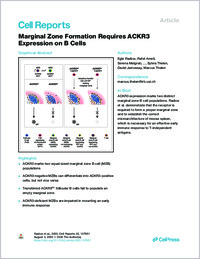
The marginal zone (MZ) contributes to the highly organized spleen microarchitecture. We show that expression of atypical chemokine receptor 3 (ACKR3) defines two equal-sized populations of mouse MZ B cells (MZBs). ACKR3 is required for development of a functional MZ and for positioning of MZBs. Deletion of ACKR3 on B cells distorts the MZ, and MZBs fail to deliver antigens to follicles, reducing humoral responses. Reconstitution of MZ-deficient CD19ko mice shows that ACKR3- MZBs can differentiate into ACKR3+ MZBs, but not vice versa. The lack of a MZ is rescued by adoptive transfer of ACKR3-sufficient, and less by ACKR3-deficient, follicular B cells (FoBs); hence, ACKR3 expression is crucial for establishment of the MZ. The inability of CD19ko mice to respond to T-independent antigen is rescued when ACKR3-proficient, but not ACKR3-deficient, FoBs are transferred. Accordingly, ACKR3-deficient FoBs are able to reconstitute the MZ if the niche is pre-established by ACKR3-proficient MZBs.
- Language
-
- English
- Open access status
- gold
- Identifiers
-
- DOI 10.1016/j.celrep.2020.107951
- PMID 32755592
- Persistent URL
- https://sonar.ch/global/documents/107297
Statistics
Document views: 47
File downloads:
- Full-text: 0