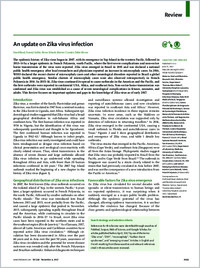
An update on Zika virus infection.
- Baud D Materno-fetal and Obstetrics Research Unit, Obstetric Service, Department "Femme-Mère-Enfant", University Hospital, Lausanne, Switzerland. Electronic address: david.baud@chuv.ch.
- Gubler DJ Program in Emerging Infectious Diseases, Duke-NUS Medical School, Singapore.
- Schaub B Centre Pluridisciplinaire de Diagnostic Prénatal de Martinique, Service de Gynécologie Obstétrique, Maison de la Femme de la Mère et de l'Enfant, Fort de France, Martinique, France; Registre des Malformations des Antilles (REMALAN), Maison de la Femme de la Mère et de l'Enfant, Centre Hospitalier Universitaire de Martinique, Fort de France, Martinique, France.
- Lanteri MC Blood Systems Research Institute, San Francisco, CA, USA; Department of Laboratory Medicine, University of California San Francisco, San Francisco, CA, USA; Cerus Corporation, Concord, CA, USA.
- Musso D Unit of Emerging Infectious Diseases, Institut Louis Malardé, Tahiti, French Polynesia.
- 2017-06-26
Published in:
- Lancet (London, England). - 2017
Communicable Disease Control
Disease Outbreaks
Female
Global Health
Humans
Incidence
Infant, Newborn
Male
Pregnancy
Prognosis
Risk Assessment
Survival Analysis
Zika Virus
Zika Virus Infection
English
The epidemic history of Zika virus began in 2007, with its emergence in Yap Island in the western Pacific, followed in 2013-14 by a larger epidemic in French Polynesia, south Pacific, where the first severe complications and non-vector-borne transmission of the virus were reported. Zika virus emerged in Brazil in 2015 and was declared a national public health emergency after local researchers and physicians reported an increase in microcephaly cases. In 2016, WHO declared the recent cluster of microcephaly cases and other neurological disorders reported in Brazil a global public health emergency. Similar clusters of microcephaly cases were also observed retrospectively in French Polynesia in 2014. In 2015-16, Zika virus continued its spread to cause outbreaks in the Americas and the Pacific, and the first outbreaks were reported in continental USA, Africa, and southeast Asia. Non-vector-borne transmission was confirmed and Zika virus was established as a cause of severe neurological complications in fetuses, neonates, and adults. This Review focuses on important updates and gaps in the knowledge of Zika virus as of early 2017.
- Language
-
- English
- Open access status
- bronze
- Identifiers
-
- DOI 10.1016/S0140-6736(17)31450-2
- PMID 28647173
- Persistent URL
- https://sonar.ch/global/documents/126155
Statistics
Document views: 115
File downloads:
- Full-text: 0