The bear circadian clock doesn't 'sleep' during winter dormancy.
- Jansen HT Department of Integrative Physiology and Neuroscience, College of Veterinary Medicine, Washington State University, Mailstop 7620, Veterinary and Biomedical Research Bldg., Room 205, Pullman, WA 99164-7620 USA.
- Leise T Department of Mathematics and Statistics, Amherst College, Amherst, MA 01002 USA.
- Stenhouse G Foothills Research Institute, Hinton, AB T7V 1X6 Canada.
- Pigeon K Foothills Research Institute, Hinton, AB T7V 1X6 Canada.
- Kasworm W U.S. Fish and Wildlife Service, Libby, MT 59923 USA.
- Teisberg J U.S. Fish and Wildlife Service, Libby, MT 59923 USA.
- Radandt T U.S. Fish and Wildlife Service, Libby, MT 59923 USA.
- Dallmann R Institute for Pharmacology and Toxicology, University of Zürich, Zürich, 8057 Switzerland ; Present address: Warwick Medical School and Warwick Systems Biology Centre, University of Warwick, Gibbet Hill Road, Coventry, CV4 7AL UK.
- Brown S Institute for Pharmacology and Toxicology, University of Zürich, Zürich, 8057 Switzerland.
- Robbins CT School of the Environment, Washington State University, Pullman, WA 99164 USA.
- 2016-09-24
Published in:
- Frontiers in zoology. - 2016
English
BACKGROUND
Most biological functions are synchronized to the environmental light:dark cycle via a circadian timekeeping system. Bears exhibit shallow torpor combined with metabolic suppression during winter dormancy. We sought to confirm that free-running circadian rhythms of body temperature (Tb) and activity were expressed in torpid grizzly (brown) bears and that they were functionally responsive to environmental light. We also measured activity and ambient light exposures in denning wild bears to determine if rhythms were evident and what the photic conditions of their natural dens were. Lastly, we used cultured skin fibroblasts obtained from captive torpid bears to assess molecular clock operation in peripheral tissues. Circadian parameters were estimated using robust wavelet transforms and maximum entropy spectral analyses.
RESULTS
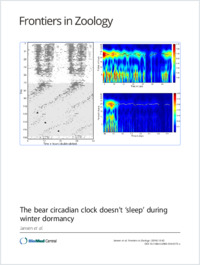
Captive grizzly bears housed in constant darkness during winter dormancy expressed circadian rhythms of activity and Tb. The rhythm period of juvenile bears was significantly shorter than that of adult bears. However, the period of activity rhythms in adult captive bears was virtually identical to that of adult wild denning bears as was the strength of the activity rhythms. Similar to what has been found in other mammals, a single light exposure during the bear's active period delayed subsequent activity onsets whereas these were advanced when light was applied during the bear's inactive period. Lastly, in vitro studies confirmed the expression of molecular circadian rhythms with a period comparable to the bear's own behavioral rhythms.
CONCLUSIONS
Based on these findings we conclude that the circadian system is functional in torpid bears and their peripheral tissues even when housed in constant darkness, is responsive to phase-shifting effects of light, and therefore, is a normal facet of torpid bear physiology.
Most biological functions are synchronized to the environmental light:dark cycle via a circadian timekeeping system. Bears exhibit shallow torpor combined with metabolic suppression during winter dormancy. We sought to confirm that free-running circadian rhythms of body temperature (Tb) and activity were expressed in torpid grizzly (brown) bears and that they were functionally responsive to environmental light. We also measured activity and ambient light exposures in denning wild bears to determine if rhythms were evident and what the photic conditions of their natural dens were. Lastly, we used cultured skin fibroblasts obtained from captive torpid bears to assess molecular clock operation in peripheral tissues. Circadian parameters were estimated using robust wavelet transforms and maximum entropy spectral analyses.
RESULTS
Captive grizzly bears housed in constant darkness during winter dormancy expressed circadian rhythms of activity and Tb. The rhythm period of juvenile bears was significantly shorter than that of adult bears. However, the period of activity rhythms in adult captive bears was virtually identical to that of adult wild denning bears as was the strength of the activity rhythms. Similar to what has been found in other mammals, a single light exposure during the bear's active period delayed subsequent activity onsets whereas these were advanced when light was applied during the bear's inactive period. Lastly, in vitro studies confirmed the expression of molecular circadian rhythms with a period comparable to the bear's own behavioral rhythms.
CONCLUSIONS
Based on these findings we conclude that the circadian system is functional in torpid bears and their peripheral tissues even when housed in constant darkness, is responsive to phase-shifting effects of light, and therefore, is a normal facet of torpid bear physiology.
- Language
-
- English
- Open access status
- gold
- Identifiers
-
- DOI 10.1186/s12983-016-0173-x
- PMID 27660641
- Persistent URL
- https://sonar.ch/global/documents/129172
Statistics
Document views: 37
File downloads:
- Full-text: 0