Evolutionary Genomics and Conservation of the Endangered Przewalski's Horse.
- Der Sarkissian C Centre for GeoGenetics, Natural History Museum of Denmark, University of Copenhagen, Copenhagen 1350K, Denmark.
- Ermini L Centre for GeoGenetics, Natural History Museum of Denmark, University of Copenhagen, Copenhagen 1350K, Denmark.
- Schubert M Centre for GeoGenetics, Natural History Museum of Denmark, University of Copenhagen, Copenhagen 1350K, Denmark.
- Yang MA Department of Integrative Biology, University of California, Berkeley, Berkeley, CA 94720-3140, USA.
- Librado P Centre for GeoGenetics, Natural History Museum of Denmark, University of Copenhagen, Copenhagen 1350K, Denmark.
- Fumagalli M Department of Genetics, Evolution and Environment, UCL Genetics Institute, University College London, London WC1E 6BT, UK.
- Jónsson H Centre for GeoGenetics, Natural History Museum of Denmark, University of Copenhagen, Copenhagen 1350K, Denmark.
- Bar-Gal GK The Robert H. Smith Faculty of Agriculture, Food and Environment, The Koret School of Veterinary Medicine, The Hebrew University, Rehovot 76100, Israel.
- Albrechtsen A Department of Biology, The Bioinformatics Centre, University of Copenhagen, Copenhagen 2200N, Denmark.
- Vieira FG Centre for GeoGenetics, Natural History Museum of Denmark, University of Copenhagen, Copenhagen 1350K, Denmark.
- Petersen B Department of Systems Biology, Center for Biological Sequence Analysis, Technical University of Denmark, Lyngby 2800, Denmark.
- Ginolhac A Centre for GeoGenetics, Natural History Museum of Denmark, University of Copenhagen, Copenhagen 1350K, Denmark.
- Seguin-Orlando A National High-Throughput DNA Sequencing Centre, University of Copenhagen, Copenhagen 1353K, Denmark.
- Magnussen K National High-Throughput DNA Sequencing Centre, University of Copenhagen, Copenhagen 1353K, Denmark.
- Fages A Centre for GeoGenetics, Natural History Museum of Denmark, University of Copenhagen, Copenhagen 1350K, Denmark.
- Gamba C Centre for GeoGenetics, Natural History Museum of Denmark, University of Copenhagen, Copenhagen 1350K, Denmark.
- Lorente-Galdos B ICREA at the Institut de Biologia Evolutiva (CSIC-University Pompeu Fabra), Barcelona 08003, Spain.
- Polani S The Robert H. Smith Faculty of Agriculture, Food and Environment, The Koret School of Veterinary Medicine, The Hebrew University, Rehovot 76100, Israel.
- Steiner C San Diego Zoo Institute for Conservation Research, Escondido, CA 92027, USA.
- Neuditschko M Agroscope, Swiss National Stud Farm, Avenches 1580, Switzerland.
- Jagannathan V Institute of Genetics, University of Bern, Bern 3001, Switzerland.
- Feh C Station Biologique de la Tour du Valat, Arles 13200, France.
- Greenblatt CL Department of Microbiology and Molecular Genetics, The Hebrew University-Hadassah Medical School, Jerusalem 91120, Israel.
- Ludwig A Department of Evolutionary Genetics, Leibniz Institute for Zoo and Wildlife Research, Berlin 10315, Germany.
- Abramson NI Zoological Institute of the Russian Academy of Sciences, Saint-Petersburg 199034, Russia.
- Zimmermann W EAZA Equid TAG, Köln 50668, Germany.
- Schafberg R Martin-Luther-University Halle-Wittenberg, Museum of Domesticated Animals "Julius Kühn", Halle 06108, Germany.
- Tikhonov A Zoological Institute of the Russian Academy of Sciences, Saint-Petersburg 199034, Russia; Institute of Applied Ecology of the North, North-Eastern Federal University, Yakutsk 677980, Russia.
- Sicheritz-Ponten T Department of Systems Biology, Center for Biological Sequence Analysis, Technical University of Denmark, Lyngby 2800, Denmark.
- Willerslev E Centre for GeoGenetics, Natural History Museum of Denmark, University of Copenhagen, Copenhagen 1350K, Denmark.
- Marques-Bonet T ICREA at the Institut de Biologia Evolutiva (CSIC-University Pompeu Fabra), Barcelona 08003, Spain; Centro Nacional de Analisis Genomico (CNAG-CRG), Barcelona 08023, Spain.
- Ryder OA San Diego Zoo Institute for Conservation Research, Escondido, CA 92027, USA.
- McCue M College of Veterinary Medicine, University of Minnesota, St. Paul, MN 55108, USA.
- Rieder S Agroscope, Swiss National Stud Farm, Avenches 1580, Switzerland.
- Leeb T Institute of Genetics, University of Bern, Bern 3001, Switzerland.
- Slatkin M Department of Integrative Biology, University of California, Berkeley, Berkeley, CA 94720-3140, USA.
- Orlando L Centre for GeoGenetics, Natural History Museum of Denmark, University of Copenhagen, Copenhagen 1350K, Denmark; Université de Toulouse, University Paul Sabatier (UPS), Laboratoire AMIS, CNRS UMR 5288, 37 Allées Jules Guesde, 31000 Toulouse, France. Electronic address: lorlando@snm.ku.dk.
- 2015-09-29
Published in:
- Current biology : CB. - 2015
Animals
Animals, Wild
Biological Evolution
Biomarkers
Breeding
Conservation of Natural Resources
Endangered Species
Genetic Variation
Genomics
Horses
Phylogeny
Sequence Analysis, DNA
English
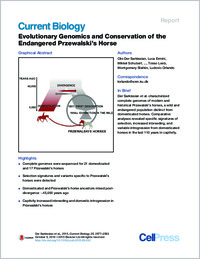
Przewalski's horses (PHs, Equus ferus ssp. przewalskii) were discovered in the Asian steppes in the 1870s and represent the last remaining true wild horses. PHs became extinct in the wild in the 1960s but survived in captivity, thanks to major conservation efforts. The current population is still endangered, with just 2,109 individuals, one-quarter of which are in Chinese and Mongolian reintroduction reserves [1]. These horses descend from a founding population of 12 wild-caught PHs and possibly up to four domesticated individuals [2-4]. With a stocky build, an erect mane, and stripped and short legs, they are phenotypically and behaviorally distinct from domesticated horses (DHs, Equus caballus). Here, we sequenced the complete genomes of 11 PHs, representing all founding lineages, and five historical specimens dated to 1878-1929 CE, including the Holotype. These were compared to the hitherto-most-extensive genome dataset characterized for horses, comprising 21 new genomes. We found that loci showing the most genetic differentiation with DHs were enriched in genes involved in metabolism, cardiac disorders, muscle contraction, reproduction, behavior, and signaling pathways. We also show that DH and PH populations split ∼45,000 years ago and have remained connected by gene-flow thereafter. Finally, we monitor the genomic impact of ∼110 years of captivity, revealing reduced heterozygosity, increased inbreeding, and variable introgression of domestic alleles, ranging from non-detectable to as much as 31.1%. This, together with the identification of ancestry informative markers and corrections to the International Studbook, establishes a framework for evaluating the persistence of genetic variation in future reintroduced populations.
- Language
-
- English
- Open access status
- bronze
- Identifiers
-
- DOI 10.1016/j.cub.2015.08.032
- PMID 26412128
- Persistent URL
- https://sonar.ch/global/documents/140658
Statistics
Document views: 120
File downloads:
- Full-text: 0