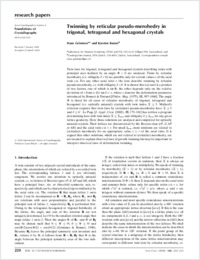
Twinning by reticular pseudo-merohedry in trigonal, tetragonal and hexagonal crystals.
- 2004-04-23
Published in:
- Acta crystallographica. Section A, Foundations of crystallography. - 2004
English
Twin laws for trigonal, tetragonal and hexagonal crystals describing twins with principal axes inclined by an angle Phi > 0 are analysed. Twins by reticular merohedry (i.e. obliquity delta = 0) are possible only for certain values s of the axial ratio c/a. For any other axial ratio r, the laws describe twinning by reticular pseudo-merohedry, i.e. with obliquity delta > 0. It is shown that (a) tandelta is a product of two factors, one of which is sinPhi, the other depends only on the relative deviation of r from s; (b) tandelta approximately epsilon, where epsilon denotes the deformation parameter introduced by Bonnet & Durand [Philos. Mag. (1975), 32, 997-1006]. The angle Phi is listed for all cases of reticular merohedry of trigonal, tetragonal and hexagonal (i.e. optically uniaxial) crystals with twin index Sigma
- Language
-
- English
- Open access status
- green
- Identifiers
-
- DOI 10.1107/S0108767304006695
- PMID 15103165
- Persistent URL
- https://sonar.ch/global/documents/142443
Statistics
Document views: 21
File downloads:
- Full-text: 0