Analysis of the Voltage Losses in CZTSSe Solar Cells of Varying Sn Content.
- Azzouzi M Department of Physics and Centre for Plastic Electronics , Imperial College London , London SW7 2AZ , United Kingdom.
- Cabas-Vidani A Laboratory for Thin Films and Photovoltaics , Empa-Swiss Federal Laboratories for Materials Science and Technology , Ueberlandstrasse 129 , 8600 Duebendorf , Switzerland.
- Haass SG Laboratory for Thin Films and Photovoltaics , Empa-Swiss Federal Laboratories for Materials Science and Technology , Ueberlandstrasse 129 , 8600 Duebendorf , Switzerland.
- Röhr JA Department of Physics and Centre for Plastic Electronics , Imperial College London , London SW7 2AZ , United Kingdom.
- Romanyuk YE Laboratory for Thin Films and Photovoltaics , Empa-Swiss Federal Laboratories for Materials Science and Technology , Ueberlandstrasse 129 , 8600 Duebendorf , Switzerland.
- Tiwari AN Laboratory for Thin Films and Photovoltaics , Empa-Swiss Federal Laboratories for Materials Science and Technology , Ueberlandstrasse 129 , 8600 Duebendorf , Switzerland.
- Nelson J Department of Physics and Centre for Plastic Electronics , Imperial College London , London SW7 2AZ , United Kingdom.
- 2019-05-10
Published in:
- The journal of physical chemistry letters. - 2019
English
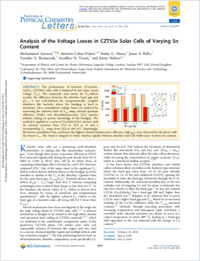
The performance of kesterite (Cu2ZnSn(S,Se)4, CZTSSe) solar cells is hindered by low open circuit voltage ( Voc). The commonly used metric for Voc-deficit, namely, the difference between the absorber band gap and qVoc, is not well-defined for compositionally complex absorbers like kesterite where the bandgap is hard to determine. Here, nonradiative voltage losses are analyzed by measuring the radiative limit of Voc, using external quantum efficiency (EQE) and electroluminescence (EL) spectra, without relying on precise knowledge of the bandgap. The method is applied to a series of Cu2ZnSn(S,Se)4 devices with Sn content variation from 27.6 to 32.9 at. % and a corresponding Voc range from 423 to 465 mV. Surprisingly, the lowest nonradiative loss, and hence the highest external luminescence efficiency (QELED), were obtained for the device with the lowest Voc. The trend is assigned to better interface quality between absorber and CdS buffer layer at lower Sn content.
- Language
-
- English
- Open access status
- hybrid
- Identifiers
-
- DOI 10.1021/acs.jpclett.9b00506
- PMID 31070031
- Persistent URL
- https://sonar.ch/global/documents/159450
Statistics
Document views: 69
File downloads:
- Full-text: 0