Delineation of phenotypes and genotypes related to cohesin structural protein RAD21.
- Krab LC Department of Pediatrics, Amsterdam UMC, University of Amsterdam, Meibergdreef 9, 1105AZ, Amsterdam, The Netherlands. lkrab@cordaan.nl.
- Marcos-Alcalde I Molecular Modelling Group, Centro de Biología Molecular Severo Ochoa, CBMSO (CSIC-UAM), Madrid, Spain.
- Assaf M Banner Childrens Specialists Neurology Clinic, Glendale, AZ, USA.
- Balasubramanian M Clinical Genetics Service, Sheffield Children's Hospital, Academic Unit for Child Health, University of Sheffield, Sheffield, UK.
- Andersen JB Department of Clinical Genetics, Kennedy Center, Copenhagen University Hospital, Rigshospitalet, Gl. Landevej 7, 2600, Glostrup, Denmark.
- Bisgaard AM Department of Pediatrics and Adolescent Medicine, Copenhagen University Hospital, Rigshospitalet, Glostrup, Denmark.
- Fitzpatrick DR MRC Human Genetics Unit, University of Edinburgh, Edinburgh, UK.
- Gudmundsson S Department of Immunology, Genetics and Pathology, Uppsala University, Uppsala, Sweden.
- Huisman SA Department of Pediatrics, Amsterdam UMC, University of Amsterdam, Meibergdreef 9, 1105AZ, Amsterdam, The Netherlands.
- Kalayci T Division of Medical Genetics, Department of Internal Medicine, Istanbul University, Istanbul, Turkey.
- Maas SM Department of Pediatrics, Amsterdam UMC, University of Amsterdam, Meibergdreef 9, 1105AZ, Amsterdam, The Netherlands.
- Martinez F Unidad de Genética, Hospital Universitario y Politécnico La Fe, Valencia, Spain.
- McKee S Northern Ireland Regional Genetics Service, Belfast City Hospital, Belfast, UK.
- Menke LA Department of Pediatrics, Amsterdam UMC, University of Amsterdam, Meibergdreef 9, 1105AZ, Amsterdam, The Netherlands.
- Mulder PA Autism Team Northern-Netherlands, Jonx Department of Youth Mental Health and Autism, Lentis Psychiatric Institute, Groningen, The Netherlands.
- Murch OD Institute of Medical Genetics, University Hospital of Wales, Cardiff, UK.
- Parker M Clinical Genetic Service, Northern General Hospital, Sheffield, UK.
- Pie J Unit of Clinical Genetics Unit, Service of Pediatrics, University Hospital "Lozano Blesa", University of Zaragoza School of Medicine, Saragossa, Spain.
- Ramos FJ Unit of Clinical Genetics Unit and Functional Genomics, Department of Pharmacology and Physiology, University of Zaragoza School of Medicine, Saragossa, Spain.
- Rieubland C Department of Pediatrics, Division of Human Genetics, Inselspital, University of Bern, Bern, Switzerland.
- Rosenfeld Mokry JA Department of Molecular and Human Genetics, Baylor College of Medicine, Baylor Genetics Laboratories, Houston, TX, USA.
- Scarano E Rare Disease Unit, Department of Pediatrics, St. Orsola Hospital, Bologna, Italy.
- Shinawi M Department of Pediatrics, Division of Genetics and Genomic Medicine, Washington University School of Medicine, St. Louis, MO, USA.
- Gómez-Puertas P Molecular Modelling Group, Centro de Biología Molecular Severo Ochoa, CBMSO (CSIC-UAM), Madrid, Spain.
- Tümer Z Department of Clinical Genetics, Kennedy Center, Copenhagen University Hospital, Rigshospitalet, Gl. Landevej 7, 2600, Glostrup, Denmark. Zeynep.tumer@regionh.dk.
- Hennekam RC Department of Pediatrics, Amsterdam UMC, University of Amsterdam, Meibergdreef 9, 1105AZ, Amsterdam, The Netherlands. R.c.hennekam@amsterdamumc.nl.
- 2020-03-21
Published in:
- Human genetics. - 2020
Adolescent
Adult
Cell Cycle Proteins
Child
Child, Preschool
Chromosome Deletion
DNA-Binding Proteins
De Lange Syndrome
Female
Genetic Association Studies
Genotype
Humans
Infant
Infant, Newborn
Male
Middle Aged
Molecular Dynamics Simulation
Mutation
Phenotype
Protein Conformation
Young Adult
English
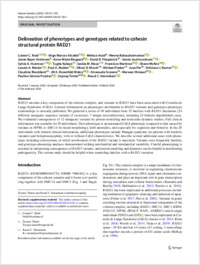
RAD21 encodes a key component of the cohesin complex, and variants in RAD21 have been associated with Cornelia de Lange Syndrome (CdLS). Limited information on phenotypes attributable to RAD21 variants and genotype-phenotype relationships is currently published. We gathered a series of 49 individuals from 33 families with RAD21 alterations [24 different intragenic sequence variants (2 recurrent), 7 unique microdeletions], including 24 hitherto unpublished cases. We evaluated consequences of 12 intragenic variants by protein modelling and molecular dynamic studies. Full clinical information was available for 29 individuals. Their phenotype is an attenuated CdLS phenotype compared to that caused by variants in NIPBL or SMC1A for facial morphology, limb anomalies, and especially for cognition and behavior. In the 20 individuals with limited clinical information, additional phenotypes include Mungan syndrome (in patients with biallelic variants) and holoprosencephaly, with or without CdLS characteristics. We describe several additional cases with phenotypes including sclerocornea, in which involvement of the RAD21 variant is uncertain. Variants were frequently familial, and genotype-phenotype analyses demonstrated striking interfamilial and intrafamilial variability. Careful phenotyping is essential in interpreting consequences of RAD21 variants, and protein modeling and dynamics can be helpful in determining pathogenicity. The current study should be helpful when counseling families with a RAD21 variation.
- Language
-
- English
- Open access status
- hybrid
- Identifiers
-
- DOI 10.1007/s00439-020-02138-2
- PMID 32193685
- Persistent URL
- https://sonar.ch/global/documents/178042
Statistics
Document views: 31
File downloads:
- Full-text: 0