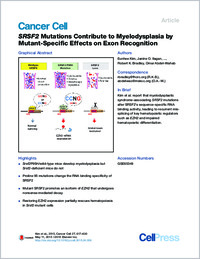
SRSF2 Mutations Contribute to Myelodysplasia by Mutant-Specific Effects on Exon Recognition.
- Kim E Human Oncology and Pathogenesis Program, Memorial Sloan Kettering Cancer Center, New York, NY 10065, USA.
- Ilagan JO Computational Biology Program, Public Health Sciences Division, Fred Hutchinson Cancer Research Center, Seattle, WA 98109, USA; Basic Sciences Division, Fred Hutchinson Cancer Research Center, Seattle, WA 98109, USA.
- Liang Y Hematology, Yale Comprehensive Cancer Center and Department of Internal Medicine, Yale University School of Medicine, New Haven, CT 06520, USA.
- Daubner GM Institute for Molecular Biology and Biophysics, ETH, 8093 Zürich, Switzerland.
- Lee SC Human Oncology and Pathogenesis Program, Memorial Sloan Kettering Cancer Center, New York, NY 10065, USA.
- Ramakrishnan A Clinical Research Division, Fred Hutchinson Cancer Research Center, Seattle, WA 98109, USA; Division of Medical Oncology, School of Medicine, University of Washington, Seattle, WA 98109, USA.
- Li Y Department of Molecular Biophysics and Biochemistry, Yale University, New Haven, CT 06520, USA.
- Chung YR Human Oncology and Pathogenesis Program, Memorial Sloan Kettering Cancer Center, New York, NY 10065, USA.
- Micol JB Human Oncology and Pathogenesis Program, Memorial Sloan Kettering Cancer Center, New York, NY 10065, USA.
- Murphy ME Clinical Research Division, Fred Hutchinson Cancer Research Center, Seattle, WA 98109, USA.
- Cho H Human Oncology and Pathogenesis Program, Memorial Sloan Kettering Cancer Center, New York, NY 10065, USA.
- Kim MK Human Oncology and Pathogenesis Program, Memorial Sloan Kettering Cancer Center, New York, NY 10065, USA.
- Zebari AS Computational Biology Program, Public Health Sciences Division, Fred Hutchinson Cancer Research Center, Seattle, WA 98109, USA; Basic Sciences Division, Fred Hutchinson Cancer Research Center, Seattle, WA 98109, USA.
- Aumann S Human Oncology and Pathogenesis Program, Memorial Sloan Kettering Cancer Center, New York, NY 10065, USA.
- Park CY Human Oncology and Pathogenesis Program, Memorial Sloan Kettering Cancer Center, New York, NY 10065, USA; Department of Pathology, Memorial Sloan Kettering Cancer Center, New York, NY 10065, USA.
- Buonamici S H3 Biomedicine, Cambridge, MA 03129, USA.
- Smith PG H3 Biomedicine, Cambridge, MA 03129, USA.
- Deeg HJ Clinical Research Division, Fred Hutchinson Cancer Research Center, Seattle, WA 98109, USA; Division of Medical Oncology, School of Medicine, University of Washington, Seattle, WA 98109, USA.
- Lobry C Institut National de la Santé et de la Recherche Medicale (INSERM) U1009, Institut Gustave Roussy, 94805 Villejuif, France; Université Paris-Sud, 91400 Orsay, France.
- Aifantis I Howard Hughes Medical Institute and Department of Pathology, New York University School of Medicine, New York, NY 10016, USA.
- Modis Y Department of Molecular Biophysics and Biochemistry, Yale University, New Haven, CT 06520, USA; Department of Medicine, University of Cambridge, MRC Laboratory of Molecular Biology, Cambridge CB2 0QH, UK.
- Allain FH Institute for Molecular Biology and Biophysics, ETH, 8093 Zürich, Switzerland.
- Halene S Hematology, Yale Comprehensive Cancer Center and Department of Internal Medicine, Yale University School of Medicine, New Haven, CT 06520, USA.
- Bradley RK Computational Biology Program, Public Health Sciences Division, Fred Hutchinson Cancer Research Center, Seattle, WA 98109, USA; Basic Sciences Division, Fred Hutchinson Cancer Research Center, Seattle, WA 98109, USA. Electronic address: rbradley@fhcrc.org.
- Abdel-Wahab O Human Oncology and Pathogenesis Program, Memorial Sloan Kettering Cancer Center, New York, NY 10065, USA; Leukemia Service, Department of Medicine, Memorial Sloan Kettering Cancer Center, New York, NY 10065, USA. Electronic address: abdelwao@mskcc.org.
- 2015-05-13
Published in:
- Cancer cell. - 2015
Animals
Enhancer of Zeste Homolog 2 Protein
Exons
Gene Expression
Mice
Mice, Mutant Strains
Mutation
Myelodysplastic Syndromes
Nuclear Proteins
Polycomb Repressive Complex 2
Proteolysis
RNA Splicing
Ribonucleoproteins
Serine-Arginine Splicing Factors
English
Mutations affecting spliceosomal proteins are the most common mutations in patients with myelodysplastic syndromes (MDS), but their role in MDS pathogenesis has not been delineated. Here we report that mutations affecting the splicing factor SRSF2 directly impair hematopoietic differentiation in vivo, which is not due to SRSF2 loss of function. By contrast, SRSF2 mutations alter SRSF2's normal sequence-specific RNA binding activity, thereby altering the recognition of specific exonic splicing enhancer motifs to drive recurrent mis-splicing of key hematopoietic regulators. This includes SRSF2 mutation-dependent splicing of EZH2, which triggers nonsense-mediated decay, which, in turn, results in impaired hematopoietic differentiation. These data provide a mechanistic link between a mutant spliceosomal protein, alterations in the splicing of key regulators, and impaired hematopoiesis.
- Language
-
- English
- Open access status
- bronze
- Identifiers
-
- DOI 10.1016/j.ccell.2015.04.006
- PMID 25965569
- Persistent URL
- https://sonar.ch/global/documents/181061
Statistics
Document views: 62
File downloads:
- Full-text: 0