Lymphographic-Like Technique for the Treatment of Microcystic Lymphatic Malformation Components of <3 mm.
- Da Ros V From the Department of Neuroradiology (V.D.R., M.I., L.S., G.S.), Bicêtre Hospital, Le Kremlin Bicêtre Cedex, France.
- Iacobucci M From the Department of Neuroradiology (V.D.R., M.I., L.S., G.S.), Bicêtre Hospital, Le Kremlin Bicêtre Cedex, France.
- Puccinelli F Department of Neuroradiology (F.P., G.S.), Centre Hospitalier Universitaire Vaudois, Lausanne, Switzerland.
- Spelle L From the Department of Neuroradiology (V.D.R., M.I., L.S., G.S.), Bicêtre Hospital, Le Kremlin Bicêtre Cedex, France.
- Saliou G Department of Neuroradiology (F.P., G.S.), Centre Hospitalier Universitaire Vaudois, Lausanne, Switzerland. guillaume.saliou@chuv.ch.
- 2017-12-02
Published in:
- AJNR. American journal of neuroradiology. - 2018
Adolescent
Adult
Bleomycin
Child
Child, Preschool
Female
Fluoroscopy
Humans
Infant
Lymphatic Abnormalities
Male
Middle Aged
Retrospective Studies
Sclerotherapy
Therapy, Computer-Assisted
Treatment Outcome
Young Adult
English
BACKGROUND AND PURPOSE
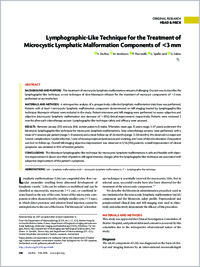
The treatment of microcystic lymphatic malformations remains challenging. Our aim was to describe the lymphographic-like technique, a new technique of slow bleomycin infusion for the treatment of microcyst components of <3 mm, performed at our institution.
MATERIALS AND METHODS
A retrospective analysis of a prospectively collected lymphatic malformation data base was performed. Patients with at least 1 microcystic lymphatic malformation component demonstrated on MR imaging treated by lymphographic-like technique bleomycin infusion were included in the study. Patient interviews and MR imaging were performed to assess subjective and objective (microcystic lymphatic malformation size decrease of >30%) clinical improvement, respectively. Patients were reviewed 3 months after each sclerotherapy session. Lymphographic-like technique safety and efficacy were assessed.
RESULTS
Between January 2012 and July 2016, sixteen patients (5 males, 11 females; mean age, 15 years; range, 1-47 years) underwent the bleomycin lymphographic-like technique for microcystic lymphatic malformations. Sixty sclerotherapy sessions were performed, with a mean of 4 sessions per patient (range, 1-8 sessions) and a mean follow-up of 26 months (range, 5-58 months). We observed no major and 3 minor complications: 1 eyelid infection, 1 case of severe postprocedural nausea and vomiting, and 1 case of skin discoloration. One patient was lost to follow-up. Overall MR imaging objective improvement was observed in 5/16 (31%) patients; overall improvement of clinical symptoms was obtained in 93% of treated patients.
CONCLUSIONS
The bleomycin lymphographic-like technique for microcystic lymphatic malformations is safe and feasible with objective improvement in about one-third of patients. MR signal intensity changes after the lymphographic-like technique are associated with subjective improvement of the patient's symptoms.
The treatment of microcystic lymphatic malformations remains challenging. Our aim was to describe the lymphographic-like technique, a new technique of slow bleomycin infusion for the treatment of microcyst components of <3 mm, performed at our institution.
MATERIALS AND METHODS
A retrospective analysis of a prospectively collected lymphatic malformation data base was performed. Patients with at least 1 microcystic lymphatic malformation component demonstrated on MR imaging treated by lymphographic-like technique bleomycin infusion were included in the study. Patient interviews and MR imaging were performed to assess subjective and objective (microcystic lymphatic malformation size decrease of >30%) clinical improvement, respectively. Patients were reviewed 3 months after each sclerotherapy session. Lymphographic-like technique safety and efficacy were assessed.
RESULTS
Between January 2012 and July 2016, sixteen patients (5 males, 11 females; mean age, 15 years; range, 1-47 years) underwent the bleomycin lymphographic-like technique for microcystic lymphatic malformations. Sixty sclerotherapy sessions were performed, with a mean of 4 sessions per patient (range, 1-8 sessions) and a mean follow-up of 26 months (range, 5-58 months). We observed no major and 3 minor complications: 1 eyelid infection, 1 case of severe postprocedural nausea and vomiting, and 1 case of skin discoloration. One patient was lost to follow-up. Overall MR imaging objective improvement was observed in 5/16 (31%) patients; overall improvement of clinical symptoms was obtained in 93% of treated patients.
CONCLUSIONS
The bleomycin lymphographic-like technique for microcystic lymphatic malformations is safe and feasible with objective improvement in about one-third of patients. MR signal intensity changes after the lymphographic-like technique are associated with subjective improvement of the patient's symptoms.
- Language
-
- English
- Open access status
- hybrid
- Identifiers
-
- DOI 10.3174/ajnr.A5449
- PMID 29191875
- Persistent URL
- https://sonar.ch/global/documents/186399
Export to…
Statistics
Document views: 61
File downloads:
- Full-text: 0