Uniparental disomy and genome imprinting: an overview.
- Engel E University of Geneva Medical School, Switzerland.
- 1996-01-01
Published in:
- Acta geneticae medicae et gemellologiae. - 1996
English
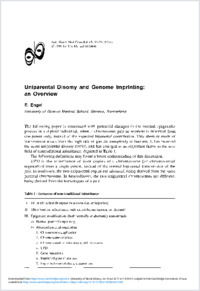
The following paper is concerned with potential changes in the normal epigenetic process in a diploid individual, when a chromosome pair or segment is inherited from one parent only, instead of the expected biparental contribution. This aberrant mode of transmission arises from the high rate of gamete aneuploidy in humans. It has received the name uniparental disomy (UPD), and has emerged as an important factor in the new field of nontraditional inheritance, depicted in Table 1. The following definitions may foster a better understanding of this discussion. UPD is the inheritance of both copies of a chromosome [or chromosomal segment(s)] from a single parent, instead of the normal biparental transmission of the pair. In isodisomy, the two uniparental copies are identical , being derived from the same parental chromosome. In heterodisomy , the two uniparental chromosomes are different , being derived from the homologues of a pair.
- Language
-
- English
- Open access status
- green
- Identifiers
-
- DOI 10.1017/s0001566000001069
- PMID 8872007
- Persistent URL
- https://sonar.ch/global/documents/200273
Statistics
Document views: 59
File downloads:
- Full-text: 0