Hypoxia Triggers the Intravasation of Clustered Circulating Tumor Cells.
- Donato C Department of Biomedicine, Cancer Metastasis Laboratory, University of Basel and University Hospital Basel, 4058 Basel, Switzerland.
- Kunz L Department of Biosystems Science and Engineering, ETH Zürich, 4058 Basel, Switzerland.
- Castro-Giner F Department of Biomedicine, Cancer Metastasis Laboratory, University of Basel and University Hospital Basel, 4058 Basel, Switzerland; SIB Swiss Institute of Bioinformatics, 1015 Lausanne, Switzerland.
- Paasinen-Sohns A Department of Biomedicine, Cancer Metastasis Laboratory, University of Basel and University Hospital Basel, 4058 Basel, Switzerland.
- Strittmatter K Department of Biomedicine, Cancer Metastasis Laboratory, University of Basel and University Hospital Basel, 4058 Basel, Switzerland.
- Szczerba BM Department of Biomedicine, Cancer Metastasis Laboratory, University of Basel and University Hospital Basel, 4058 Basel, Switzerland.
- Scherrer R Department of Biomedicine, Cancer Metastasis Laboratory, University of Basel and University Hospital Basel, 4058 Basel, Switzerland.
- Di Maggio N Department of Biomedicine, Cell and Gene Therapy Laboratory, University of Basel and University Hospital Basel, 4056 Basel, Switzerland.
- Heusermann W IMCF Imaging Core Facility Biozentrum, University of Basel, 4056 Basel, Switzerland.
- Biehlmaier O IMCF Imaging Core Facility Biozentrum, University of Basel, 4056 Basel, Switzerland.
- Beisel C Department of Biosystems Science and Engineering, ETH Zürich, 4058 Basel, Switzerland.
- Vetter M Gynecologic Cancer Center, University Hospital Basel, 4056 Basel, Switzerland; Department of Medical Oncology, University Hospital Basel, 4056 Basel, Switzerland; Breast Cancer Center, University Hospital Basel, 4056 Basel, Switzerland.
- Rochlitz C Department of Medical Oncology, University Hospital Basel, 4056 Basel, Switzerland; Breast Cancer Center, University Hospital Basel, 4056 Basel, Switzerland.
- Weber WP Breast Cancer Center, University Hospital Basel, 4056 Basel, Switzerland; Department of Surgery, University of Basel and University Hospital Basel, 4056 Basel, Switzerland.
- Banfi A Department of Biomedicine, Cell and Gene Therapy Laboratory, University of Basel and University Hospital Basel, 4056 Basel, Switzerland.
- Schroeder T Department of Biosystems Science and Engineering, ETH Zürich, 4058 Basel, Switzerland.
- Aceto N Department of Biomedicine, Cancer Metastasis Laboratory, University of Basel and University Hospital Basel, 4058 Basel, Switzerland. Electronic address: nicola.aceto@unibas.ch.
- 2020-09-09
Published in:
- Cell reports. - 2020
English
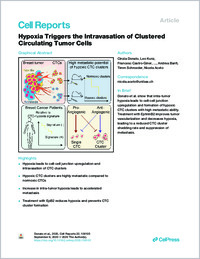
Circulating tumor cells (CTCs) are shed from solid cancers in the form of single or clustered cells, and the latter display an extraordinary ability to initiate metastasis. Yet, the biological phenomena that trigger the shedding of CTC clusters from a primary cancerous lesion are poorly understood. Here, when dynamically labeling breast cancer cells along cancer progression, we observe that the majority of CTC clusters are undergoing hypoxia, while single CTCs are largely normoxic. Strikingly, we find that vascular endothelial growth factor (VEGF) targeting leads to primary tumor shrinkage, but it increases intra-tumor hypoxia, resulting in a higher CTC cluster shedding rate and metastasis formation. Conversely, pro-angiogenic treatment increases primary tumor size, yet it dramatically suppresses the formation of CTC clusters and metastasis. Thus, intra-tumor hypoxia leads to the formation of clustered CTCs with high metastatic ability, and a pro-angiogenic therapy suppresses metastasis formation through prevention of CTC cluster generation.
- Language
-
- English
- Open access status
- gold
- Identifiers
-
- DOI 10.1016/j.celrep.2020.108105
- PMID 32905777
- Persistent URL
- https://sonar.ch/global/documents/200802
Export to…
Statistics
Document views: 133
File downloads:
- Full-text: 0