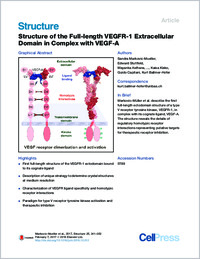
Structure of the Full-length VEGFR-1 Extracellular Domain in Complex with VEGF-A.
- Markovic-Mueller S Paul Scherrer Institute, Laboratory of Biomolecular Research, 5232 Villigen, Switzerland.
- Stuttfeld E Biozentrum, University of Basel, 4056 Basel, Switzerland.
- Asthana M Paul Scherrer Institute, Laboratory of Biomolecular Research, 5232 Villigen, Switzerland.
- Weinert T Paul Scherrer Institute, Laboratory of Biomolecular Research, 5232 Villigen, Switzerland.
- Bliven S Paul Scherrer Institute, Laboratory of Biomolecular Research, 5232 Villigen, Switzerland; National Center for Biotechnology Information, National Library of Medicine, National Institutes of Health, Bethesda, MD 20894, USA.
- Goldie KN Center for Cellular Imaging and Nano Analytics (C-CINA), Biozentrum, University of Basel, 4056 Basel, Switzerland.
- Kisko K Paul Scherrer Institute, Laboratory of Biomolecular Research, 5232 Villigen, Switzerland.
- Capitani G Paul Scherrer Institute, Laboratory of Biomolecular Research, 5232 Villigen, Switzerland.
- Ballmer-Hofer K Paul Scherrer Institute, Laboratory of Biomolecular Research, 5232 Villigen, Switzerland. Electronic address: kurt.ballmer-hofer@unibas.ch.
- 2017-01-24
Published in:
- Structure (London, England : 1993). - 2017
VEGF receptor
X-ray crystallography
angiogenesis
extracellular domain
receptor tyrosine kinase
single-particle negative stain electron microscopy
small-angle X-ray scattering
vascular endothelial growth factor
Amino Acid Sequence
Binding Sites
Cloning, Molecular
Crystallography, X-Ray
Gene Expression
Humans
Ligands
Microscopy, Electron
Models, Molecular
Protein Binding
Protein Conformation, alpha-Helical
Protein Conformation, beta-Strand
Protein Interaction Domains and Motifs
Protein Multimerization
Recombinant Proteins
Sequence Alignment
Sequence Homology, Amino Acid
Thermodynamics
Vascular Endothelial Growth Factor A
Vascular Endothelial Growth Factor Receptor-1
English
Vascular endothelial growth factors (VEGFs) regulate blood and lymph vessel development upon activation of three receptor tyrosine kinases: VEGFR-1, -2, and -3. Partial structures of VEGFR/VEGF complexes based on single-particle electron microscopy, small-angle X-ray scattering, and X-ray crystallography revealed the location of VEGF binding and domain arrangement of individual receptor subdomains. Here, we describe the structure of the full-length VEGFR-1 extracellular domain in complex with VEGF-A at 4 Å resolution. We combined X-ray crystallography, single-particle electron microscopy, and molecular modeling for structure determination and validation. The structure reveals the molecular details of ligand-induced receptor dimerization, in particular of homotypic receptor interactions in immunoglobulin homology domains 4, 5, and 7. Functional analyses of ligand binding and receptor activation confirm the relevance of these homotypic contacts and identify them as potential therapeutic sites to allosterically inhibit VEGFR-1 activity.
- Language
-
- English
- Open access status
- bronze
- Identifiers
-
- DOI 10.1016/j.str.2016.12.012
- PMID 28111021
- Persistent URL
- https://sonar.ch/global/documents/202374
Export to…
Statistics
Document views: 109
File downloads:
- Full-text: 0