Circadian and Feeding Rhythms Orchestrate the Diurnal Liver Acetylome.
- Mauvoisin D Diabetes and Circadian Rhythms Department, Nestlé Institute of Health Sciences, 1015 Lausanne, Switzerland; Institute of Bioengineering, School of Life Sciences, Ecole Polytechnique Fédérale de Lausanne, 1015 Lausanne, Switzerland.
- Atger F Diabetes and Circadian Rhythms Department, Nestlé Institute of Health Sciences, 1015 Lausanne, Switzerland; Department of Pharmacology and Toxicology, University of Lausanne, 1015 Lausanne, Switzerland.
- Dayon L Systems Nutrition, Metabonomics & Proteomics, Nestlé Institute of Health Sciences, 1015 Lausanne, Switzerland.
- Núñez Galindo A Systems Nutrition, Metabonomics & Proteomics, Nestlé Institute of Health Sciences, 1015 Lausanne, Switzerland.
- Wang J Institute of Bioengineering, School of Life Sciences, Ecole Polytechnique Fédérale de Lausanne, 1015 Lausanne, Switzerland.
- Martin E Diabetes and Circadian Rhythms Department, Nestlé Institute of Health Sciences, 1015 Lausanne, Switzerland.
- Da Silva L Systems Nutrition, Metabonomics & Proteomics, Nestlé Institute of Health Sciences, 1015 Lausanne, Switzerland.
- Montoliu I Systems Nutrition, Metabonomics & Proteomics, Nestlé Institute of Health Sciences, 1015 Lausanne, Switzerland.
- Collino S Systems Nutrition, Metabonomics & Proteomics, Nestlé Institute of Health Sciences, 1015 Lausanne, Switzerland.
- Martin FP Systems Nutrition, Metabonomics & Proteomics, Nestlé Institute of Health Sciences, 1015 Lausanne, Switzerland.
- Ratajczak J Diabetes and Circadian Rhythms Department, Nestlé Institute of Health Sciences, 1015 Lausanne, Switzerland; School of Life Sciences, Ecole Polytechnique Fédérale Lausanne, 1015 Lausanne, Switzerland.
- Cantó C Diabetes and Circadian Rhythms Department, Nestlé Institute of Health Sciences, 1015 Lausanne, Switzerland; School of Life Sciences, Ecole Polytechnique Fédérale Lausanne, 1015 Lausanne, Switzerland.
- Kussmann M Systems Nutrition, Metabonomics & Proteomics, Nestlé Institute of Health Sciences, 1015 Lausanne, Switzerland.
- Naef F Institute of Bioengineering, School of Life Sciences, Ecole Polytechnique Fédérale de Lausanne, 1015 Lausanne, Switzerland.
- Gachon F Diabetes and Circadian Rhythms Department, Nestlé Institute of Health Sciences, 1015 Lausanne, Switzerland; School of Life Sciences, Ecole Polytechnique Fédérale Lausanne, 1015 Lausanne, Switzerland. Electronic address: frederic.gachon@rd.nestle.com.
- 2017-08-17
Published in:
- Cell reports. - 2017
NAD(+)
SILAC proteomics
SIRT3
acetylation
circadian clock
liver metabolism
ARNTL Transcription Factors
Acetylation
Animals
Circadian Clocks
Circadian Rhythm
Cryptochromes
Eating
Liver
Lysine
Metabolic Networks and Pathways
Mice
Mice, Inbred C57BL
Mice, Knockout
Mitochondrial Proteins
NAD
Photoperiod
Protein Processing, Post-Translational
Proteome
Sirtuin 3
English
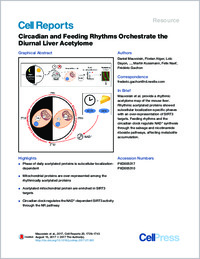
Lysine acetylation is involved in various biological processes and is considered a key reversible post-translational modification in the regulation of gene expression, enzyme activity, and subcellular localization. This post-translational modification is therefore highly relevant in the context of circadian biology, but its characterization on the proteome-wide scale and its circadian clock dependence are still poorly described. Here, we provide a comprehensive and rhythmic acetylome map of the mouse liver. Rhythmic acetylated proteins showed subcellular localization-specific phases that correlated with the related metabolites in the regulated pathways. Mitochondrial proteins were over-represented among the rhythmically acetylated proteins and were highly correlated with SIRT3-dependent deacetylation. SIRT3 activity being nicotinamide adenine dinucleotide (NAD)+ level-dependent, we show that NAD+ is orchestrated by both feeding rhythms and the circadian clock through the NAD+ salvage pathway but also via the nicotinamide riboside pathway. Hence, the diurnal acetylome relies on a functional circadian clock and affects important diurnal metabolic pathways in the mouse liver.
- Language
-
- English
- Open access status
- gold
- Identifiers
-
- DOI 10.1016/j.celrep.2017.07.065
- PMID 28813682
- Persistent URL
- https://sonar.ch/global/documents/20287
Export to…
Statistics
Document views: 118
File downloads:
- Full-text: 0