Impairing L-Threonine Catabolism Promotes Healthspan through Methylglyoxal-Mediated Proteohormesis.
- Ravichandran M Energy Metabolism Laboratory, Institute of Translational Medicine, D-HEST, Swiss Federal Institute of Technology (ETH) Zürich, Schwerzenbach 8603, Switzerland; Life Sciences Zürich Graduate School, Molecular and Translational Biomedicine Program, Zurich 8044, Switzerland.
- Priebe S Systems Biology and Bioinformatics Group, Leibniz Institute for Natural Product Research and Infection Biology, Hans-Knöll-Institute, Jena 07745, Germany.
- Grigolon G Energy Metabolism Laboratory, Institute of Translational Medicine, D-HEST, Swiss Federal Institute of Technology (ETH) Zürich, Schwerzenbach 8603, Switzerland.
- Rozanov L Energy Metabolism Laboratory, Institute of Translational Medicine, D-HEST, Swiss Federal Institute of Technology (ETH) Zürich, Schwerzenbach 8603, Switzerland; Life Sciences Zürich Graduate School, Molecular and Translational Biomedicine Program, Zurich 8044, Switzerland.
- Groth M Genome Analysis Group, Leibniz Institute on Aging, Fritz Lipmann Institute, Jena 07745, Germany.
- Laube B Energy Metabolism Laboratory, Institute of Translational Medicine, D-HEST, Swiss Federal Institute of Technology (ETH) Zürich, Schwerzenbach 8603, Switzerland.
- Guthke R Systems Biology and Bioinformatics Group, Leibniz Institute for Natural Product Research and Infection Biology, Hans-Knöll-Institute, Jena 07745, Germany.
- Platzer M Genome Analysis Group, Leibniz Institute on Aging, Fritz Lipmann Institute, Jena 07745, Germany.
- Zarse K Energy Metabolism Laboratory, Institute of Translational Medicine, D-HEST, Swiss Federal Institute of Technology (ETH) Zürich, Schwerzenbach 8603, Switzerland.
- Ristow M Energy Metabolism Laboratory, Institute of Translational Medicine, D-HEST, Swiss Federal Institute of Technology (ETH) Zürich, Schwerzenbach 8603, Switzerland. Electronic address: michael-ristow@ethz.ch.
- 2018-03-20
Published in:
- Cell metabolism. - 2018
aging
diabetes
healthspan
hormesis
lifespan
longevity
metabolism
proteostasis
proteotoxicity
reactive oxygen species
Acetyltransferases
Animals
Caenorhabditis elegans
Caenorhabditis elegans Proteins
DNA-Binding Proteins
Longevity
Oxidative Stress
Proteasome Endopeptidase Complex
Pyruvaldehyde
Signal Transduction
Threonine
Transcription Factors
English
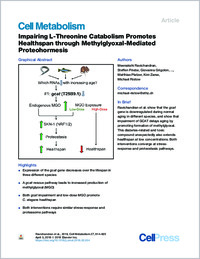
Whether and how regulation of genes and pathways contributes to physiological aging is topic of intense scientific debate. By performing an RNA expression-based screen for genes downregulated during aging of three different species, we identified glycine-C-acetyltransferase (GCAT, EC 2.3.1.29). Impairing gcat expression promotes the lifespan of C. elegans by interfering with threonine catabolism to promote methylglyoxal (MGO; CAS 78-98-8) formation in an amine oxidase-dependent manner. MGO is a reactive dicarbonyl inducing diabetic complications in mammals by causing oxidative stress and damaging cellular components, including proteins. While high concentrations of MGO consistently exert toxicity in nematodes, we unexpectedly find that low-dose MGO promotes lifespan, resembling key mediators of gcat impairment. These were executed by the ubiquitin-proteasome system, namely PBS-3 and RPN-6.1 subunits, regulated by the stress-responsive transcriptional regulators SKN-1/NRF2 and HSF-1. Taken together, GCAT acts as an evolutionary conserved aging-related gene by orchestrating an unexpected nonlinear impact of proteotoxic MGO on longevity.
- Language
-
- English
- Open access status
- bronze
- Identifiers
-
- DOI 10.1016/j.cmet.2018.02.004
- PMID 29551589
- Persistent URL
- https://sonar.ch/global/documents/223724
Statistics
Document views: 79
File downloads:
- Full-text: 0