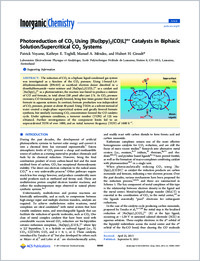
Photoreduction of CO2 using [Ru(bpy)2(CO)L]n+ catalysts in biphasic solution/supercritical CO2 systems.
- Voyame P Laboratoire Electrochimie Physique et Analytique, Ecole Polytechnique Fédérale de Lausanne , Station 6, CH-1015, Lausanne, Switzerland.
- Toghill KE
- Méndez MA
- Girault HH
- 2013-09-11
Published in:
- Inorganic chemistry. - 2013
English
The reduction of CO2 in a biphasic liquid-condensed gas system was investigated as a function of the CO2 pressure. Using 1-benzyl-1,4-dihydronicotinamide (BNAH) as sacrificial electron donor dissolved in a dimethylformamide-water mixture and [Ru(bpy)2(CO)L](n+) as a catalyst and [Ru(bpy)3](2+) as a photosensitizer, the reaction was found to produce a mixture of CO and formate, in total about 250 μmol after just 2 h. As CO2 pressure increases, CO formation is greatly favored, being four times greater than that of formate in aqueous systems. In contrast, formate production was independent of CO2 pressure, present at about 50 μmol. Using TEOA as a solvent instead of water created a single-phase supercritical system and greatly favored formate synthesis, but similarly increasing CO2 concentration favored the CO catalytic cycle. Under optimum conditions, a turnover number (TON) of 125 was obtained. Further investigations of the component limits led to an unprecedented TON of over 1000, and an initial turnover frequency (TOF) of 1600 h(-1).
- Language
-
- English
- Open access status
- green
- Identifiers
-
- DOI 10.1021/ic401031j
- PMID 24016208
- Persistent URL
- https://sonar.ch/global/documents/231449
Statistics
Document views: 31
File downloads:
- Full-text: 0