Ribonuclease-Mediated Control of Body Fat.
- Habacher C Friedrich Miescher Institute for Biomedical Research, Basel 4058, Switzerland; University of Basel, Petersplatz 1, 4003 Basel, Switzerland.
- Guo Y Friedrich Miescher Institute for Biomedical Research, Basel 4058, Switzerland.
- Venz R Friedrich Miescher Institute for Biomedical Research, Basel 4058, Switzerland; University of Basel, Petersplatz 1, 4003 Basel, Switzerland.
- Kumari P Friedrich Miescher Institute for Biomedical Research, Basel 4058, Switzerland.
- Neagu A Friedrich Miescher Institute for Biomedical Research, Basel 4058, Switzerland.
- Gaidatzis D Friedrich Miescher Institute for Biomedical Research, Basel 4058, Switzerland; Swiss Institute of Bioinformatics, 4058 Basel, Switzerland.
- Harvald EB Department of Biochemistry and Molecular Biology, University of Southern Denmark, Villum Center for Bioanalytical Sciences, 5230 Odense M, Denmark.
- Færgeman NJ Department of Biochemistry and Molecular Biology, University of Southern Denmark, Villum Center for Bioanalytical Sciences, 5230 Odense M, Denmark.
- Gut H Friedrich Miescher Institute for Biomedical Research, Basel 4058, Switzerland.
- Ciosk R Friedrich Miescher Institute for Biomedical Research, Basel 4058, Switzerland. Electronic address: rafal.ciosk@fmi.ch.
- 2016-10-18
Published in:
- Developmental cell. - 2016
ETS-4
MCPIP1
PIN domain
REGE-1
RNA degradation
Regnase-1
Zc3h12a
innate immunity
lipid metabolism
obesity
3' Untranslated Regions
Adipose Tissue
Animals
Caenorhabditis elegans
Caenorhabditis elegans Proteins
Cold Temperature
Endoribonucleases
Gene Expression Regulation
Genome, Helminth
Intestines
Models, Molecular
RNA Interference
Ribonucleases
Transcription Factors
Transcription, Genetic
English
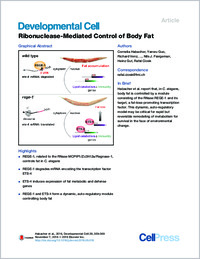
Obesity is a global health issue, arousing interest in molecular mechanisms controlling fat. Transcriptional regulation of fat has received much attention, and key transcription factors involved in lipid metabolism, such as SBP-1/SREBP, LPD-2/C/EBP, and MDT-15, are conserved from nematodes to mammals. However, there is a growing awareness that lipid metabolism can also be controlled by post-transcriptional mechanisms. Here, we show that the Caenorhabditis elegans RNase, REGE-1, related to MCPIP1/Zc3h12a/Regnase-1, a key regulator of mammalian innate immunity, promotes accumulation of body fat. Using exon-intron split analysis, we find that REGE-1 promotes fat by degrading the mRNA encoding ETS-4, a fat-loss-promoting transcription factor. Because ETS-4, in turn, induces rege-1 transcription, REGE-1 and ETS-4 appear to form an auto-regulatory module. We propose that this type of fat regulation may be of key importance when, if faced with an environmental change, an animal must rapidly but precisely remodel its metabolism.
- Language
-
- English
- Open access status
- bronze
- Identifiers
-
- DOI 10.1016/j.devcel.2016.09.018
- PMID 27746047
- Persistent URL
- https://sonar.ch/global/documents/232277
Statistics
Document views: 20
File downloads:
- Full-text: 0