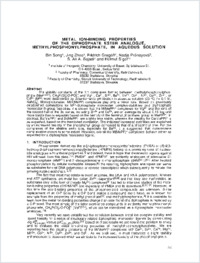
Metal Ion-Binding Properties of the Diphosphate Ester Analogue,
Methylphosphonylphosphate, in Aqueous Solution
- Song, Bin Institute of Inorganic Chemistry, University of Basel, Spitalstrasse 51, Basel CH-4056, Switzerland
- Zhao, Jing Institute of Inorganic Chemistry, University of Basel, Spitalstrasse 51, Basel CH-4056, Switzerland
- Gregáň, Fridrich Faculty of Pharmacy, Comenius University, Kalinčiaková 8, Bratislava 83232, Slovakia
- Prónayová, Nadja Faculty of Chemistry, Slovak University of Technology, Radlinskeho 9, Bratislava 81237, Slovakia
- Sajadi, S. Ali A. Institute of Inorganic Chemistry, University of Basel, Spitalstrasse 51, Basel CH-4056, Switzerland
- Sigel, Helmut Institute of Inorganic Chemistry, University of Basel, Spitalstrasse 51, Basel CH-4056, Switzerland
Published in:
- Metal-Based Drugs. - Hindawi Limited. - 1999, vol. 6, no. 6, p. 321-328
English
The stability constants of the 1:1 complexes formed between methylphosphonylphosphate ( MePP 3- ) , CH 3 P ( O ) 2 - -O-PO 3 2-
, andMg 2+ , Ca 2+ , Sr 2+ , Ba 2+ , Mn 2+ , Co 2+ , Ni 2+ , Cu 2+ , Zn 2+ , or Cd 2+ ( M 2+ )
were determined by potentiometric pH titration in aqueous solution (25 C °
; l = 0.1 M,
NaNO 3
). Monoprotonated M(H;MePP) complexes play only a minor role. Based on previously
established correlations forM 2+
-diphosphate monoester complex-stabilities and diphosphate
monoester β-group. basicities, it is shown that theM ( Mepp ) -
complexes forMg 2+
and the ions of
the second half of the 3d series, includingZn 2+
andCd 2+
more stable than is expected based on the basicity of the terminal phosphate group inMePP 3- Ba ( Mepp ) -
andSr ( Mepp ) -
are slightly less stable, whereas the stability forCa ( Mepp ) -
is
as expected, based on the mentioned correlation. The indicated increased stabilities are explained
by an increased basicity of the phosphonyl group compared to that of a phosphoryl one. For the
complexes of the alkaline earth ions, especially forBa 2+
complexation occurs to some extent. However, overall theM ( Mepp ) -
complexes behave rather as
expected for a diphosphate monoester ligand.
, and
were determined by potentiometric pH titration in aqueous solution (
; l = 0.1 M,
). Monoprotonated M(H;MePP) complexes play only a minor role. Based on previously
established correlations for
-diphosphate monoester complex-stabilities and diphosphate
monoester β-group. basicities, it is shown that the
complexes for
and the ions of
the second half of the 3d series, including
and
more stable than is expected based on the basicity of the terminal phosphate group in
and
are slightly less stable, whereas the stability for
is
as expected, based on the mentioned correlation. The indicated increased stabilities are explained
by an increased basicity of the phosphonyl group compared to that of a phosphoryl one. For the
complexes of the alkaline earth ions, especially for
complexation occurs to some extent. However, overall the
complexes behave rather as
expected for a diphosphate monoester ligand.
- Language
-
- English
- Open access status
- gold
- Identifiers
-
- DOI 10.1155/mbd.1999.321
- ISSN 0793-0291
- Persistent URL
- https://sonar.ch/global/documents/247439
Statistics
Document views: 31
File downloads:
- Full-text: 0