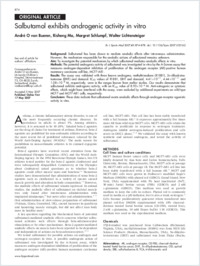
Salbutamol exhibits androgenic activity in vitro.
- von Bueren AO Institute of Pharmacology and Toxicology, University of Zurich, Switzerland. Andre.vonBueren@kispi.uzh.ch
- Ma R
- Schlumpf M
- Lichtensteiger W
- 2007-05-19
Published in:
- British journal of sports medicine. - 2007
Adrenergic beta-Agonists
Albuterol
Androgens
Breast Neoplasms
Cell Line, Tumor
Cell Proliferation
Estradiol
Estrogens
Humans
English
BACKGROUND
Salbutamol has been shown to mediate anabolic effects after intravenous administration. However, the mechanism responsible for the anabolic actions of salbutamol remains unknown.
AIM
To investigate the potential mechanism by which salbutamol mediates anabolic effects in vitro.
METHODS
The potential androgenic activity of salbutamol was investigated in vitro by the A-Screen assay that measures androgen-dependent inhibition of proliferation of the androgen receptor (AR)-positive human mammary carcinoma cell line, MCF7-AR1.
RESULTS
The assay was validated with three known androgens; methyltrienolone (R1881), 5alpha-dihydrotestosterone (DHT) and danazol. IC50 values of R1881, DHT and danazol, 4.41x10(-11), 4.44x10(-11) and 1.08x10(-8) M, respectively, were in the ranges known from earlier studies. Our results demonstrate that salbutamol exhibits androgenic activity, with an IC50 value of 8.93x10(-6) M. Anti-estrogenic or cytotoxic effects, which might have interfered with the assay, were excluded by additional experiments on wild-type MCF7 and MCF7-AR1 cells, respectively.
CONCLUSION
These data indicate that salbutamol exerts anabolic effects through androgen receptor agonistic activity in vitro.
- Language
-
- English
- Open access status
- green
- Identifiers
-
- DOI 10.1136/bjsm.2007.035162
- PMID 17510230
- Persistent URL
- https://sonar.ch/global/documents/253229
Export to…
Statistics
Document views: 84
File downloads:
- Full-text: 0