A Bacterial Effector Reveals the V-ATPase-ATG16L1 Axis that Initiates Xenophagy.
- Xu Y College of Biological Sciences, China Agricultural University, 100094 Beijing, China; National Institute of Biological Sciences, Beijing, 102206 Beijing, China.
- Zhou P National Institute of Biological Sciences, Beijing, 102206 Beijing, China.
- Cheng S Institute of Analytical Chemistry & Synthetic and Functional Biomolecules Center, College of Chemistry and Molecular Engineering, Peking University, 100871 Beijing, China.
- Lu Q National Institute of Biological Sciences, Beijing, 102206 Beijing, China.
- Nowak K Department of Molecular Mechanisms of Disease, University of Zurich, 8057 Zurich, Switzerland.
- Hopp AK Department of Molecular Mechanisms of Disease, University of Zurich, 8057 Zurich, Switzerland.
- Li L National Institute of Biological Sciences, Beijing, 102206 Beijing, China.
- Shi X National Institute of Biological Sciences, Beijing, 102206 Beijing, China.
- Zhou Z National Institute of Biological Sciences, Beijing, 102206 Beijing, China.
- Gao W National Institute of Biological Sciences, Beijing, 102206 Beijing, China.
- Li D National Institute of Biological Sciences, Beijing, 102206 Beijing, China.
- He H National Institute of Biological Sciences, Beijing, 102206 Beijing, China.
- Liu X Institute of Analytical Chemistry & Synthetic and Functional Biomolecules Center, College of Chemistry and Molecular Engineering, Peking University, 100871 Beijing, China.
- Ding J National Institute of Biological Sciences, Beijing, 102206 Beijing, China; National Laboratory of Biomacromolecules, Institute of Biophysics, Chinese Academy of Sciences, 100101 Beijing, China.
- Hottiger MO Department of Molecular Mechanisms of Disease, University of Zurich, 8057 Zurich, Switzerland.
- Shao F National Institute of Biological Sciences, Beijing, 102206 Beijing, China; Tsinghua Institute of Multidisciplinary Biomedical Research, Tsinghua University, 102206 Beijing, China. Electronic address: shaofeng@nibs.ac.cn.
- 2019-07-23
Published in:
- Cell. - 2019
ADP-ribosylation
V-ATPase
autophagy
bacteria-host interaction
innate immunity
type III secretion system
xenophagy
ADP-Ribosylation
Autophagy-Related Proteins
Bacterial Proteins
CRISPR-Cas Systems
Gene Editing
HeLa Cells
Humans
Macroautophagy
Microtubule-Associated Proteins
Protein Binding
Salmonella
Type III Secretion Systems
Vacuolar Proton-Translocating ATPases
Virulence Factors
English
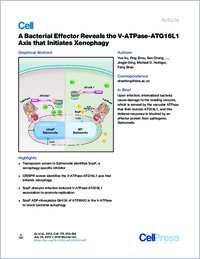
Antibacterial autophagy (xenophagy) is an important host defense, but how it is initiated is unclear. Here, we performed a bacterial transposon screen and identified a T3SS effector SopF that potently blocked Salmonella autophagy. SopF was a general xenophagy inhibitor without affecting canonical autophagy. S. Typhimurium ΔsopF resembled S. flexneri ΔvirAΔicsB with the majority of intracellular bacteria targeted by autophagy, permitting a CRISPR screen that identified host V-ATPase as an essential factor. Upon bacteria-caused vacuolar damage, the V-ATPase recruited ATG16L1 onto bacteria-containing vacuole, which was blocked by SopF. Mammalian ATG16L1 bears a WD40 domain required for interacting with the V-ATPase. Inhibiting autophagy by SopF promoted S. Typhimurium proliferation in vivo. SopF targeted Gln124 of ATP6V0C in the V-ATPase for ADP-ribosylation. Mutation of Gln124 also blocked xenophagy, but not canonical autophagy. Thus, the discovery of SopF reveals the V-ATPase-ATG16L1 axis that critically mediates autophagic recognition of intracellular pathogen.
- Language
-
- English
- Open access status
- bronze
- Identifiers
-
- DOI 10.1016/j.cell.2019.06.007
- PMID 31327526
- Persistent URL
- https://sonar.ch/global/documents/271330
Export to…
Statistics
Document views: 90
File downloads:
- Full-text: 0