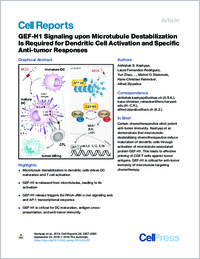
GEF-H1 Signaling upon Microtubule Destabilization Is Required for Dendritic Cell Activation and Specific Anti-tumor Responses.
- Kashyap AS Department of Biomedicine, University Hospital Basel and University of Basel, 4031 Basel, Switzerland; Gastrointestinal Unit and Center for the Study of Inflammatory Bowel Disease, Massachusetts General Hospital, Harvard Medical School, Boston, MA 02114, USA. Electronic address: abhishek.kashyap@unibas.ch.
- Fernandez-Rodriguez L Department of Biomedicine, University Hospital Basel and University of Basel, 4031 Basel, Switzerland.
- Zhao Y Gastrointestinal Unit and Center for the Study of Inflammatory Bowel Disease, Massachusetts General Hospital, Harvard Medical School, Boston, MA 02114, USA.
- Monaco G Department of Biomedicine, University Hospital Basel and University of Basel, 4031 Basel, Switzerland.
- Trefny MP Department of Biomedicine, University Hospital Basel and University of Basel, 4031 Basel, Switzerland.
- Yoshida N Gastrointestinal Unit and Center for the Study of Inflammatory Bowel Disease, Massachusetts General Hospital, Harvard Medical School, Boston, MA 02114, USA.
- Martin K Department of Biomedicine, University Hospital Basel and University of Basel, 4031 Basel, Switzerland.
- Sharma A Laboratory of Biomolecular Research, Division of Biology and Chemistry, Paul Scherrer Institut, 5232 Villigen, Switzerland.
- Olieric N Laboratory of Biomolecular Research, Division of Biology and Chemistry, Paul Scherrer Institut, 5232 Villigen, Switzerland.
- Shah P Gastrointestinal Unit and Center for the Study of Inflammatory Bowel Disease, Massachusetts General Hospital, Harvard Medical School, Boston, MA 02114, USA.
- Stanczak M Department of Biomedicine, University Hospital Basel and University of Basel, 4031 Basel, Switzerland.
- Kirchhammer N Department of Biomedicine, University Hospital Basel and University of Basel, 4031 Basel, Switzerland.
- Park SM Gastrointestinal Unit and Center for the Study of Inflammatory Bowel Disease, Massachusetts General Hospital, Harvard Medical School, Boston, MA 02114, USA.
- Wieckowski S Department of Biomedicine, University Hospital Basel and University of Basel, 4031 Basel, Switzerland.
- Laubli H Department of Biomedicine, University Hospital Basel and University of Basel, 4031 Basel, Switzerland; Medical Oncology, University Hospital Basel, 4031 Basel, Switzerland.
- Zagani R Gastrointestinal Unit and Center for the Study of Inflammatory Bowel Disease, Massachusetts General Hospital, Harvard Medical School, Boston, MA 02114, USA.
- Kasenda B Medical Oncology, University Hospital Basel, 4031 Basel, Switzerland.
- Steinmetz MO Laboratory of Biomolecular Research, Division of Biology and Chemistry, Paul Scherrer Institut, 5232 Villigen, Switzerland; University of Basel, Biozentrum, 4056 Basel, Switzerland.
- Reinecker HC Gastrointestinal Unit and Center for the Study of Inflammatory Bowel Disease, Massachusetts General Hospital, Harvard Medical School, Boston, MA 02114, USA. Electronic address: hans-christian_reinecker@hms.harvard.edu.
- Zippelius A Department of Biomedicine, University Hospital Basel and University of Basel, 4031 Basel, Switzerland; Medical Oncology, University Hospital Basel, 4031 Basel, Switzerland. Electronic address: alfred.zippelius@usb.ch.
- 2019-09-26
Published in:
- Cell reports. - 2019
GEF-H1
JNK pathway
ansamitocin-P3
chemotherapy
cross presentation
dendritic cells
immunotherapy
lfc
microtubule-targeting agents
plinabulin
Cell Differentiation
Dendritic Cells
Humans
Microtubules
Neoplasms
Rho Guanine Nucleotide Exchange Factors
Signal Transduction
English
Dendritic cell (DC) activation is a critical step for anti-tumor T cell responses. Certain chemotherapeutics can influence DC function. Here we demonstrate that chemotherapy capable of microtubule destabilization has direct effects on DC function; namely, it induces potent DC maturation and elicits anti-tumor immunity. Guanine nucleotide exchange factor-H1 (GEF-H1) is specifically released upon microtubule destabilization and is required for DC activation. In response to chemotherapy, GEF-H1 drives a distinct cell signaling program in DCs dominated by the c-Jun N-terminal kinase (JNK) pathway and AP-1/ATF transcriptional response for control of innate and adaptive immune responses. Microtubule destabilization, and subsequent GEF-H1 signaling, enhances cross-presentation of tumor antigens to CD8 T cells. In absence of GEF-H1, anti-tumor immunity is hampered. In cancer patients, high expression of the GEF-H1 immune gene signature is associated with prolonged survival. Our study identifies an alternate intracellular axis in DCs induced upon microtubule destabilization in which GEF-H1 promotes protective anti-tumor immunity.
- Language
-
- English
- Open access status
- gold
- Identifiers
-
- DOI 10.1016/j.celrep.2019.08.057
- PMID 31553907
- Persistent URL
- https://sonar.ch/global/documents/277508
Statistics
Document views: 89
File downloads:
- Full-text: 0