ABCB5 Identifies Immunoregulatory Dermal Cells.
- Schatton T Department of Dermatology, Brigham and Women's Hospital, Boston, MA 02115, USA; Transplantation Research Center, Boston Children's Hospital and Brigham and Women's Hospital, Boston, MA 02115, USA.
- Yang J Transplantation Research Center, Boston Children's Hospital and Brigham and Women's Hospital, Boston, MA 02115, USA; Institute of Organ Transplantation, Huazhong University of Science and Technology, Wuhan 430074, China.
- Kleffel S Department of Dermatology, Brigham and Women's Hospital, Boston, MA 02115, USA.
- Uehara M Transplantation Research Center, Boston Children's Hospital and Brigham and Women's Hospital, Boston, MA 02115, USA.
- Barthel SR Department of Dermatology, Brigham and Women's Hospital, Boston, MA 02115, USA.
- Schlapbach C Department of Dermatology, Brigham and Women's Hospital, Boston, MA 02115, USA; Department of Dermatology, University of Bern, Bern 3012, Switzerland.
- Zhan Q Department of Pathology, Brigham and Women's Hospital, Boston, MA 02115, USA.
- Dudeney S Department of Dermatology, Brigham and Women's Hospital, Boston, MA 02115, USA.
- Mueller H Department of Dermatology, Brigham and Women's Hospital, Boston, MA 02115, USA.
- Lee N Department of Dermatology, Brigham and Women's Hospital, Boston, MA 02115, USA.
- de Vries JC Department of Dermatology and Allergic Diseases, University of Ulm, Ulm 89077, Germany.
- Meier B Department of Dermatology and Allergic Diseases, University of Ulm, Ulm 89077, Germany.
- Vander Beken S Department of Dermatology and Allergic Diseases, University of Ulm, Ulm 89077, Germany.
- Kluth MA Rheacell GmbH & Co. KG, Heidelberg 69120, Germany.
- Ganss C Rheacell GmbH & Co. KG, Heidelberg 69120, Germany.
- Sharpe AH Department of Pathology, Brigham and Women's Hospital, Boston, MA 02115, USA; Department of Microbiology and Immunobiology, Harvard Medical School, Boston, MA 02115, USA; Evergrande Center for Immunologic Diseases, Brigham and Women's Hospital, Boston, MA 02115, USA.
- Waaga-Gasser AM Department of Surgery, University of Würzburg Medical School, Würzburg 97080, Germany.
- Sayegh MH Transplantation Research Center, Boston Children's Hospital and Brigham and Women's Hospital, Boston, MA 02115, USA.
- Abdi R Transplantation Research Center, Boston Children's Hospital and Brigham and Women's Hospital, Boston, MA 02115, USA.
- Scharffetter-Kochanek K Department of Dermatology and Allergic Diseases, University of Ulm, Ulm 89077, Germany.
- Murphy GF Department of Pathology, Brigham and Women's Hospital, Boston, MA 02115, USA.
- Kupper TS Department of Dermatology, Brigham and Women's Hospital, Boston, MA 02115, USA.
- Frank NY Transplantation Research Center, Boston Children's Hospital and Brigham and Women's Hospital, Boston, MA 02115, USA; Department of Medicine, Boston VA Healthcare System, West Roxbury, MA 02132, USA; Division of Genetics, Brigham and Women's Hospital, Boston, MA 02115, USA.
- Frank MH Department of Dermatology, Brigham and Women's Hospital, Boston, MA 02115, USA; Transplantation Research Center, Boston Children's Hospital and Brigham and Women's Hospital, Boston, MA 02115, USA; School of Medical Sciences, Edith Cowan University, Joondalup, WA 6027, Australia. Electronic address: markus.frank@childrens.harvard.edu.
- 2015-09-01
Published in:
- Cell reports. - 2015
ATP Binding Cassette Transporter, Subfamily B
ATP Binding Cassette Transporter, Subfamily B, Member 1
Allografts
Animals
Biomarkers
Cell Proliferation
Cells, Cultured
Dermis
Graft Survival
Heart Transplantation
Humans
Mice
Mice, Inbred BALB C
Mice, Inbred C3H
Mice, Inbred C57BL
Mice, Knockout
Programmed Cell Death 1 Receptor
T-Lymphocytes
T-Lymphocytes, Regulatory
English
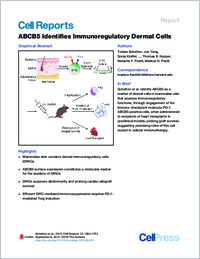
Cell-based strategies represent a new frontier in the treatment of immune-mediated disorders. However, the paucity of markers for isolation of molecularly defined immunomodulatory cell populations poses a barrier to this field. Here, we show that ATP-binding cassette member B5 (ABCB5) identifies dermal immunoregulatory cells (DIRCs) capable of exerting therapeutic immunoregulatory functions through engagement of programmed cell death 1 (PD-1). Purified Abcb5(+) DIRCs suppressed T cell proliferation, evaded immune rejection, homed to recipient immune tissues, and induced Tregs in vivo. In fully major-histocompatibility-complex-mismatched cardiac allotransplantation models, allogeneic DIRCs significantly prolonged allograft survival. Blockade of DIRC-expressed PD-1 reversed the inhibitory effects of DIRCs on T cell activation, inhibited DIRC-dependent Treg induction, and attenuated DIRC-induced prolongation of cardiac allograft survival, indicating that DIRC immunoregulatory function is mediated, at least in part, through PD-1. Our results identify ABCB5(+) DIRCs as a distinct immunoregulatory cell population and suggest promising roles of this expandable cell subset in cellular immunotherapy.
- Language
-
- English
- Open access status
- gold
- Identifiers
-
- DOI 10.1016/j.celrep.2015.08.010
- PMID 26321644
- Persistent URL
- https://sonar.ch/global/documents/278589
Statistics
Document views: 19
File downloads:
- Full-text: 0