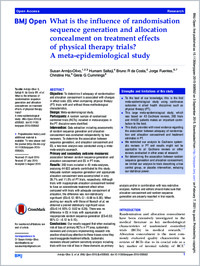
What is the influence of randomisation sequence generation and allocation concealment on treatment effects of physical therapy trials? A meta-epidemiological study.
- Armijo-Olivo S CLEAR Outcomes (Connecting Leadership, Education and Research) Research Program, University of Alberta, Edmonton Clinic Health Academy (ECHA), Edmonton, Alberta, Canada Faculty of Rehabilitation Medicine, Department of Physical Therapy, University of Alberta, Edmonton, Alberta, Canada Faculty of Rehabilitation Medicine, Rehabilitation Research Center, University of Alberta, Edmonton, Alberta, Canada.
- Saltaji H Orthodontic Graduate Clinic, School of Dentistry, University of Alberta, Edmonton, Alberta, Canada.
- da Costa BR Universitat Bern, Institute of Primary Health Care, Bern, Switzerland.
- Fuentes J Faculty of Rehabilitation Medicine, University of Alberta, Edmonton, Alberta, Canada Department of Physical Therapy, Catholic University of Maule, Talca, Chile.
- Ha C Faculty of Rehabilitation Medicine, Rehabilitation Research Center, University of Alberta, Edmonton, Alberta, Canada.
- Cummings GG Faculty of Nursing, CLEAR Outcomes (Connecting Leadership Education & Research) Research Program, University of Alberta, Edmonton Clinic Health Academy|University of Alberta, Edmonton, Alberta, Canada.
- 2015-09-05
Published in:
- BMJ open. - 2015
allocation concealment
meta-epidemiological
physical therapy
risk of bias
sequence generation
Bias
Epidemiologic Studies
Humans
Physical Therapy Modalities
Randomized Controlled Trials as Topic
Risk Assessment
English
OBJECTIVE
To determine if adequacy of randomisation and allocation concealment is associated with changes in effect sizes (ES) when comparing physical therapy (PT) trials with and without these methodological characteristics.
DESIGN
Meta-epidemiological study.
PARTICIPANTS
A random sample of randomised controlled trials (RCTs) included in meta-analyses in the PT discipline were identified.
INTERVENTION
Data extraction including assessments of random sequence generation and allocation concealment was conducted independently by two reviewers. To determine the association between sequence generation, and allocation concealment and ES, a two-level analysis was conducted using a meta-meta-analytic approach.
PRIMARY AND SECONDARY OUTCOME MEASURES
association between random sequence generation and allocation concealment and ES in PT trials.
RESULTS
393 trials included in 43 meta-analyses, analysing 44,622 patients contributed to this study. Adequate random sequence generation and appropriate allocation concealment were accomplished in only 39.7% and 11.5% of PT trials, respectively. Although trials with inappropriate allocation concealment tended to have an overestimate treatment effect when compared with trials with adequate concealment of allocation, the difference was non-statistically significant (ES=0.12; 95% CI -0.06 to 0.30). When pooling our results with those of Nuesch et al, we obtained a pooled statistically significant value (ES=0.14; 95% CI 0.02 to 0.26). There was no difference in ES in trials with appropriate or inappropriate random sequence generation (ES=0.02; 95% CI -0.12 to 0.15).
CONCLUSIONS
Our results suggest that when evaluating risk of bias of primary RCTs in PT area, systematic reviewers and clinicians implementing research into practice should pay attention to these biases since they could exaggerate treatment effects. Systematic reviewers should perform sensitivity analysis including trials with low risk of bias in these domains as primary analysis and/or in combination with less restrictive analyses. Authors and editors should make sure that allocation concealment and random sequence generation are properly reported in trial reports.
To determine if adequacy of randomisation and allocation concealment is associated with changes in effect sizes (ES) when comparing physical therapy (PT) trials with and without these methodological characteristics.
DESIGN
Meta-epidemiological study.
PARTICIPANTS
A random sample of randomised controlled trials (RCTs) included in meta-analyses in the PT discipline were identified.
INTERVENTION
Data extraction including assessments of random sequence generation and allocation concealment was conducted independently by two reviewers. To determine the association between sequence generation, and allocation concealment and ES, a two-level analysis was conducted using a meta-meta-analytic approach.
PRIMARY AND SECONDARY OUTCOME MEASURES
association between random sequence generation and allocation concealment and ES in PT trials.
RESULTS
393 trials included in 43 meta-analyses, analysing 44,622 patients contributed to this study. Adequate random sequence generation and appropriate allocation concealment were accomplished in only 39.7% and 11.5% of PT trials, respectively. Although trials with inappropriate allocation concealment tended to have an overestimate treatment effect when compared with trials with adequate concealment of allocation, the difference was non-statistically significant (ES=0.12; 95% CI -0.06 to 0.30). When pooling our results with those of Nuesch et al, we obtained a pooled statistically significant value (ES=0.14; 95% CI 0.02 to 0.26). There was no difference in ES in trials with appropriate or inappropriate random sequence generation (ES=0.02; 95% CI -0.12 to 0.15).
CONCLUSIONS
Our results suggest that when evaluating risk of bias of primary RCTs in PT area, systematic reviewers and clinicians implementing research into practice should pay attention to these biases since they could exaggerate treatment effects. Systematic reviewers should perform sensitivity analysis including trials with low risk of bias in these domains as primary analysis and/or in combination with less restrictive analyses. Authors and editors should make sure that allocation concealment and random sequence generation are properly reported in trial reports.
- Language
-
- English
- Open access status
- gold
- Identifiers
-
- DOI 10.1136/bmjopen-2015-008562
- PMID 26338841
- Persistent URL
- https://sonar.ch/global/documents/278594
Statistics
Document views: 43
File downloads:
- Full-text: 0