CUL3-KBTBD6/KBTBD7 ubiquitin ligase cooperates with GABARAP proteins to spatially restrict TIAM1-RAC1 signaling.
- Genau HM Institute of Biochemistry II, Goethe University School of Medicine, 60590 Frankfurt am Main, Germany.
- Huber J Institute of Biophysical Chemistry and Center for Biomolecular Magnetic Resonance, Goethe University, 60438 Frankfurt am Main, Germany.
- Baschieri F Department of Biology, University of Konstanz, 78464 Konstanz, Germany; Biotechnology Institute Thurgau, 8280 Kreuzlingen, Switzerland.
- Akutsu M Buchmann Institute for Molecular Life Sciences, Goethe University, 60438 Frankfurt am Main, Germany.
- Dötsch V Institute of Biophysical Chemistry and Center for Biomolecular Magnetic Resonance, Goethe University, 60438 Frankfurt am Main, Germany.
- Farhan H Department of Biology, University of Konstanz, 78464 Konstanz, Germany; Biotechnology Institute Thurgau, 8280 Kreuzlingen, Switzerland.
- Rogov V Institute of Biophysical Chemistry and Center for Biomolecular Magnetic Resonance, Goethe University, 60438 Frankfurt am Main, Germany.
- Behrends C Institute of Biochemistry II, Goethe University School of Medicine, 60590 Frankfurt am Main, Germany. Electronic address: behrends@em.uni-frankfurt.de.
- 2015-02-17
Published in:
- Molecular cell. - 2015
Adaptor Proteins, Signal Transducing
Amino Acid Sequence
Autophagy-Related Protein 8 Family
Cullin Proteins
Guanine Nucleotide Exchange Factors
Humans
Microfilament Proteins
Microtubule-Associated Proteins
Models, Molecular
Molecular Sequence Data
Multiprotein Complexes
Nuclear Magnetic Resonance, Biomolecular
Protein Conformation
Protein Multimerization
Signal Transduction
T-Lymphoma Invasion and Metastasis-inducing Protein 1
Trans-Activators
Ubiquitination
rac1 GTP-Binding Protein
English
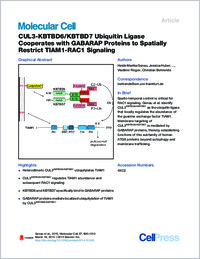
The small Rho GTPase RAC1 is an essential regulator of cellular signaling that controls actin rearrangements and cell motility. Here, we identify a novel CUL3 RING ubiquitin ligase complex, containing the substrate adaptors KBTBD6 and KBTBD7, that mediates ubiquitylation and proteasomal degradation of TIAM1, a RAC1-specific GEF. Increasing the abundance of TIAM1 by depletion of KBTBD6 and/or KBTBD7 leads to elevated RAC1 activity, changes in actin morphology, loss of focal adhesions, reduced proliferation, and enhanced invasion. KBTBD6 and KBTBD7 employ ATG8 family-interacting motifs to bind preferentially to GABARAP proteins. Surprisingly, ubiquitylation and degradation of TIAM1 by CUL3(KBTBD6/KBTBD7) depends on its binding to GABARAP proteins. Our study reveals that recruitment of CUL3(KBTBD6/KBTBD7) to GABARAP-containing vesicles regulates the abundance of membrane-associated TIAM1 and subsequently spatially restricted RAC1 signaling. Besides their role in autophagy and trafficking, we uncovered a previously unknown function of GABARAP proteins as membrane-localized signaling scaffolds.
- Language
-
- English
- Open access status
- bronze
- Identifiers
-
- DOI 10.1016/j.molcel.2014.12.040
- PMID 25684205
- Persistent URL
- https://sonar.ch/global/documents/279130
Export to…
Statistics
Document views: 71
File downloads:
- Full-text: 0