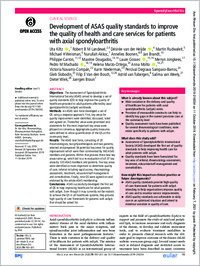
Development of ASAS quality standards to improve the quality of health and care services for patients with axial spondyloarthritis.
- Kiltz U Rheumatology, Rheumazentrum Ruhrgebiet, Ruhr-University Bochum, Herne, Germany uta.kiltz@elisabethgruppe.de.
- Landewé RBM Amsterdam Rheumatology Center, AMC, Amsterdam, The Netherlands.
- van der Heijde D Rheumatology, Leiden University Medical Center, Leiden, The Netherlands.
- Rudwaleit M Internal Medicine and Rheumatology, Klinikum Bielefeld Rosenhöhe, Bielefeld, Germany.
- Weisman MH Division of Rheumatology, Department of Medicine, David Geffen School of Medicine, Los Angeles, California, USA.
- Akkoc N Department of Medicine, Division of Rheumatology, Celal Bayar University School of Medicine, Manisa, Turkey.
- Boonen A Internal Medicine, Division of Rheumatology, Maastrich University Medical Center, Maastricht, The Netherlands.
- Brandt J Rheumatology, Private Practice, Berlin, Germany.
- Carron P Rheumatology, Ghent University Hospital, Ghent, Belgium.
- Dougados M Hopital Cochin, Rheumatology, Université Paris Descartes, Paris, France.
- Gossec L Institut Pierre Louis d'Epidémiologie et de Santé Publique (iPLESP), UMR S 1136, Sorbonne Universite, Paris, France.
- Jongkees M Patient Research Partner, Amsterdam, The Netherlands.
- Machado PM MRC Centre for Neuromuscular Diseases, University College London, London, UK.
- Marzo-Ortega H NIHR Leeds Biomedical Research Centre, Leeds Teaching Hospitals Trust and Leeds Institute of Rheumatic and Musculoskeletal Disease, University of Leeds Faculty of Medicine and Health, Leeds, UK.
- Molto A INSERM (U1153): Epidémiologie Clinique et Biostatistiques, PRES Sorbonne Paris-Cité, Paris, France.
- Navarro-Compán V Department of Rheumatology, University Hospital La Paz, IdiPaz, Madrid, Spain.
- Niederman K School of Health Professions, Institute of Physiotherapy, Zurich University of Applied Sciences, Winterthur, Switzerland.
- Sampaio-Barros PD Faculdade de Medicina da Universidade de São Paulo e Hospital das Clínicas da Faculdade de Medicina da Universidade de São Paulo, Sao Paulo, Brazil.
- Slobodin G Department of Internal Medicine A, Bnai Zion Medical Center, Technion, Haifa, Israel.
- Van den Bosch FE VIB Inflammation Research Center, Ghent, Belgium.
- van Tubergen A Internal Medicine, Division of Rheumatology, Maastrich University Medical Center, Maastricht, The Netherlands.
- van Weely S Reade, Centre for Rehabilitation and Rheumatology, Amsterdam, The Netherlands.
- Wiek D Patient Research Partner, Huenxe, Germany.
- Braun J Rheumatology, Rheumazentrum Ruhrgebiet, Ruhr-University Bochum, Herne, Germany.
- 2019-10-13
Published in:
- Annals of the rheumatic diseases. - 2020
ankylosing spondylitis
quality Indicators
spondyloarthritis
Adult
Advisory Committees
Consensus
Delivery of Health Care
Female
Humans
Male
Quality Improvement
Rheumatology
Societies, Medical
Spondylarthritis
English
OBJECTIVES
The Assessment of SpondyloArthritis International Society (ASAS) aimed to develop a set of quality standards (QS) to help improve the quality of healthcare provided to adult patients affected by axial spondyloarthritis (axSpA) worldwide.
METHODS
An ASAS task force developed a set of QS using a stepwise approach. First, key areas for quality improvement were identified, discussed, rated and agreed on. Thereafter, areas were prioritised and statements for the most important key areas were phrased on consensus. Appropriate quality measures were defined to allow quantification of the QS at the community level.
RESULTS
The ASAS task force, consisting of 20 rheumatologists, two physiotherapists and two patients, selected and proposed 34 potential key areas for quality improvement which were then commented by 140 ASAS members and patients. Within that process three new key areas came up, which led to a re-evaluation of all 37 key areas by 120 ASAS members and patients. Five key areas were identified as most important to determine quality of care: referral including rapid access, rheumatology assessment, treatment, education/self-management and comorbidities. Finally, nine QS were agreed on and endorsed by the whole ASAS membership.
CONCLUSIONS
ASAS successfully developed the first set of QS to help improving healthcare for adult patients with axSpA. Even though it may currently not be realistic to achieve the QS in all healthcare systems, they provide high-quality of care framework for patients with axSpA that should be aimed for.
The Assessment of SpondyloArthritis International Society (ASAS) aimed to develop a set of quality standards (QS) to help improve the quality of healthcare provided to adult patients affected by axial spondyloarthritis (axSpA) worldwide.
METHODS
An ASAS task force developed a set of QS using a stepwise approach. First, key areas for quality improvement were identified, discussed, rated and agreed on. Thereafter, areas were prioritised and statements for the most important key areas were phrased on consensus. Appropriate quality measures were defined to allow quantification of the QS at the community level.
RESULTS
The ASAS task force, consisting of 20 rheumatologists, two physiotherapists and two patients, selected and proposed 34 potential key areas for quality improvement which were then commented by 140 ASAS members and patients. Within that process three new key areas came up, which led to a re-evaluation of all 37 key areas by 120 ASAS members and patients. Five key areas were identified as most important to determine quality of care: referral including rapid access, rheumatology assessment, treatment, education/self-management and comorbidities. Finally, nine QS were agreed on and endorsed by the whole ASAS membership.
CONCLUSIONS
ASAS successfully developed the first set of QS to help improving healthcare for adult patients with axSpA. Even though it may currently not be realistic to achieve the QS in all healthcare systems, they provide high-quality of care framework for patients with axSpA that should be aimed for.
- Language
-
- English
- Open access status
- hybrid
- Identifiers
-
- DOI 10.1136/annrheumdis-2019-216034
- PMID 31604704
- Persistent URL
- https://sonar.ch/global/documents/279177
Statistics
Document views: 45
File downloads:
- Full-text: 0