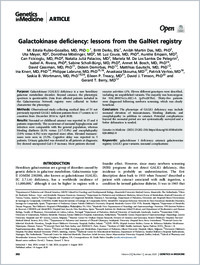
Galactokinase deficiency: lessons from the GalNet registry.
- Rubio-Gozalbo ME Department of Pediatrics and Clinical Genetics, GROW-School for Oncology and Developmental Biology, Maastricht University Medical Centre, Maastricht, The Netherlands. estela.rubio@mumc.nl.
- Derks B Department of Pediatrics and Clinical Genetics, GROW-School for Oncology and Developmental Biology, Maastricht University Medical Centre, Maastricht, The Netherlands.
- Das AM Clinic for Paediatric Kidney-, Liver- and Metabolic Diseases, Hannover, Germany.
- Meyer U Clinic for Paediatric Kidney-, Liver- and Metabolic Diseases, Hannover, Germany.
- Möslinger D Department for Pediatrics and Adolescent Medicine, Inborn Errors of Metabolism, Medical University of Vienna, Vienna, Austria.
- Couce ML Unit of Diagnosis and Treatment of Congenital Metabolic Diseases, S. Neonatology, Department of Pediatrics, University and Hospital Clínico Universitario de Santiago de Compostela, CIBERER, Health Research Institute of Santiago de Compostela (IDIS), MetabERN: European Reference Network for Rare Hereditary Metabolic Disorders, Santiago de Compostela, Spain.
- Empain A Department of Pediatrics, Queen Fabiola Children's University Hospital, Metabolic Centre ULB-VUB, Brussels, Belgium.
- Ficicioglu C Department of Metabolic Disease Program, The Children's Hospital of Philadelphia, Philadelphia, PA, USA.
- Juliá Palacios N Metabolic Unit. Departments of Neurology and Gastroenterology-Nutrition. IPR (Institut Pediàtric de Recerca), CIBERER and MetabERN. Hospital Sant Joan de Déu, Barcelona, Spain.
- De Los Santos De Pelegrin MM Metabolic Unit. Departments of Neurology and Gastroenterology-Nutrition. IPR (Institut Pediàtric de Recerca), CIBERER and MetabERN. Hospital Sant Joan de Déu, Barcelona, Spain.
- Rivera IA Research Institute for Medicines (iMed.ULisboa), and Department of Biochemistry and Human Biology, Faculty of Pharmacy, Universidade de Lisboa, Lisbon, Portugal.
- Scholl-Bürgi S Department of Pediatrics, Medical University of Innsbruck, Innsbruck, Austria.
- Bosch AM Amsterdam UMC, University of Amsterdam, Pediatric Metabolic Diseases, Emma Children's Hospital, Amsterdam, Netherlands.
- Cassiman D Metabolic Center, Department of Gastroenterology-Hepatology, Leuven University Hospitals and KU Leuven, Leuven, Belgium.
- Demirbas D Manton Center for Orphan Disease Research, Division of Genetics and Genomics, Boston Children's Hospital, Harvard Medical School, Boston, MA, USA.
- Gautschi M Department of Pediatrics and Institute of Clinical Chemistry, Inselspital, University Hospital Bern, Bern, Switzerland.
- Knerr I National Centre for Inherited Metabolic Disorders, Temple Street Children's University Hospital, Dublin, Ireland.
- Labrune P APHP, HUPS, Hôpital Antoine Béclère, Centre de Référence Maladies Héréditaires Hépatiques, Clamart, France.
- Skouma A Institute of Child Health, Institouto Ygeias Paidiou (ICH), Thivon 1 & Papadiamantopoulou, Athens, Greece.
- Verloo P Division of Child Neurology and Metabolism, Department of Pediatrics, Ghent University Hospital, Ghent, Belgium.
- Wortmann SB University Children's Hospital, Parcelsus Medical University (PMU), Salzburg, Austria.
- Treacy EP National Centre for Inherited Metabolic Disorders-Adult Services, Mater Misericordiae University Hospital, Dublin, Ireland.
- Timson DJ School of Pharmacy and Biomolecular Sciences, University of Brighton, Brighton, UK.
- Berry GT Manton Center for Orphan Disease Research, Division of Genetics and Genomics, Boston Children's Hospital, Harvard Medical School, Boston, MA, USA.
- 2020-08-19
Published in:
- Genetics in medicine : official journal of the American College of Medical Genetics. - 2020
GALK1 gene variants; neonatal complications
cataract; galactosemias registry
galactokinase 1 deficiency
English
PURPOSE
Galactokinase (GALK1) deficiency is a rare hereditary galactose metabolism disorder. Beyond cataract, the phenotypic spectrum is questionable. Data from affected patients included in the Galactosemias Network registry were collected to better characterize the phenotype.
METHODS
Observational study collecting medical data of 53 not previously reported GALK1 deficient patients from 17 centers in 11 countries from December 2014 to April 2020.
RESULTS
Neonatal or childhood cataract was reported in 15 and 4 patients respectively. The occurrence of neonatal hypoglycemia and infection were comparable with the general population, whereas bleeding diathesis (8.1% versus 2.17-5.9%) and encephalopathy (3.9% versus 0.3%) were reported more often. Elevated transaminases were seen in 25.5%. Cognitive delay was reported in 5 patients. Urinary galactitol was elevated in all patients at diagnosis; five showed unexpected Gal-1-P increase. Most patients showed enzyme activities ≤1%. Eleven different genotypes were described, including six unpublished variants. The majority was homozygous for NM_000154.1:c.82C>A (p.Pro28Thr). Thirty-five patients were diagnosed following newborn screening, which was clearly beneficial.
CONCLUSION
The phenotype of GALK1 deficiency may include neonatal elevation of transaminases, bleeding diathesis, and encephalopathy in addition to cataract. Potential complications beyond the neonatal period are not systematically surveyed and a better delineation is needed.
Galactokinase (GALK1) deficiency is a rare hereditary galactose metabolism disorder. Beyond cataract, the phenotypic spectrum is questionable. Data from affected patients included in the Galactosemias Network registry were collected to better characterize the phenotype.
METHODS
Observational study collecting medical data of 53 not previously reported GALK1 deficient patients from 17 centers in 11 countries from December 2014 to April 2020.
RESULTS
Neonatal or childhood cataract was reported in 15 and 4 patients respectively. The occurrence of neonatal hypoglycemia and infection were comparable with the general population, whereas bleeding diathesis (8.1% versus 2.17-5.9%) and encephalopathy (3.9% versus 0.3%) were reported more often. Elevated transaminases were seen in 25.5%. Cognitive delay was reported in 5 patients. Urinary galactitol was elevated in all patients at diagnosis; five showed unexpected Gal-1-P increase. Most patients showed enzyme activities ≤1%. Eleven different genotypes were described, including six unpublished variants. The majority was homozygous for NM_000154.1:c.82C>A (p.Pro28Thr). Thirty-five patients were diagnosed following newborn screening, which was clearly beneficial.
CONCLUSION
The phenotype of GALK1 deficiency may include neonatal elevation of transaminases, bleeding diathesis, and encephalopathy in addition to cataract. Potential complications beyond the neonatal period are not systematically surveyed and a better delineation is needed.
- Language
-
- English
- Open access status
- hybrid
- Identifiers
-
- DOI 10.1038/s41436-020-00942-9
- PMID 32807972
- Persistent URL
- https://sonar.ch/global/documents/284438
Statistics
Document views: 56
File downloads:
- Full-text: 0