Comprehensive Analysis of Alternative Splicing Across Tumors from 8,705 Patients.
- Kahles A ETH Zurich, Department of Computer Science, Zurich, Switzerland; Memorial Sloan Kettering Cancer Center, Computational Biology Department, New York, USA; University Hospital Zurich, Biomedical Informatics Research, Zurich, Switzerland; SIB Swiss Institute of Bioinformatics, Zurich, Switzerland.
- Lehmann KV ETH Zurich, Department of Computer Science, Zurich, Switzerland; Memorial Sloan Kettering Cancer Center, Computational Biology Department, New York, USA; University Hospital Zurich, Biomedical Informatics Research, Zurich, Switzerland; SIB Swiss Institute of Bioinformatics, Zurich, Switzerland.
- Toussaint NC ETH Zurich, NEXUS Personalized Health Technologies, Zurich, Switzerland; SIB Swiss Institute of Bioinformatics, Zurich, Switzerland.
- Hüser M ETH Zurich, Department of Computer Science, Zurich, Switzerland; University Hospital Zurich, Biomedical Informatics Research, Zurich, Switzerland; SIB Swiss Institute of Bioinformatics, Zurich, Switzerland.
- Stark SG ETH Zurich, Department of Computer Science, Zurich, Switzerland; Memorial Sloan Kettering Cancer Center, Computational Biology Department, New York, USA; University Hospital Zurich, Biomedical Informatics Research, Zurich, Switzerland; SIB Swiss Institute of Bioinformatics, Zurich, Switzerland.
- Sachsenberg T University of Tübingen, Department of Computer Science, Tübingen, Germany.
- Stegle O European Molecular Biology Laboratory, European Bioinformatics Institute, Hinxton, Cambridge, UK.
- Kohlbacher O University of Tübingen, Department of Computer Science, Tübingen, Germany; Center for Bioinformatics, University of Tübingen, Tübingen, Germany; Quantitative Biology Center, University of Tübingen, Tübingen, Germany; Biomolecular Interactions, Max Planck Institute for Developmental Biology, Tübingen, Germany; Institute for Translational Bioinformatics, University Medical Center, Tübingen, Germany.
- Sander C Dana-Farber Cancer Institute, cBio Center, Department of Biostatistics and Computational Biology, Boston, MA, USA; Harvard Medical School, CompBio Collaboratory, Department of Cell Biology, Boston, USA.
- Rätsch G
- 2018-08-07
Published in:
- Cancer cell. - 2018
CPTAC
GTEx
MS proteomics
RNA-seq
TCGA
TCGA Pan-Cancer Atlas
alternative splicing
cancer
exome
immunoediting
immunotherapy
neoantigens
splicing QTL
tumor-specific splicing
Alternative Splicing
Humans
Neoplasms
Polymorphism, Single Nucleotide
Quantitative Trait Loci
Sequence Analysis, RNA
Whole Exome Sequencing
English
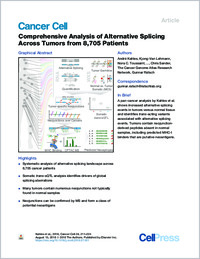
Our comprehensive analysis of alternative splicing across 32 The Cancer Genome Atlas cancer types from 8,705 patients detects alternative splicing events and tumor variants by reanalyzing RNA and whole-exome sequencing data. Tumors have up to 30% more alternative splicing events than normal samples. Association analysis of somatic variants with alternative splicing events confirmed known trans associations with variants in SF3B1 and U2AF1 and identified additional trans-acting variants (e.g., TADA1, PPP2R1A). Many tumors have thousands of alternative splicing events not detectable in normal samples; on average, we identified ≈930 exon-exon junctions ("neojunctions") in tumors not typically found in GTEx normals. From Clinical Proteomic Tumor Analysis Consortium data available for breast and ovarian tumor samples, we confirmed ≈1.7 neojunction- and ≈0.6 single nucleotide variant-derived peptides per tumor sample that are also predicted major histocompatibility complex-I binders ("putative neoantigens").
- Language
-
- English
- Open access status
- hybrid
- Identifiers
-
- DOI 10.1016/j.ccell.2018.07.001
- PMID 30078747
- Persistent URL
- https://sonar.ch/global/documents/286763
Statistics
Document views: 60
File downloads:
- Full-text: 0