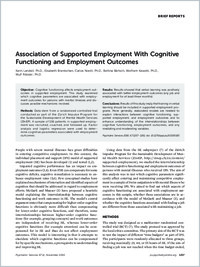
Association of Supported Employment With Cognitive Functioning and Employment Outcomes.
- Landolt K The authors are with the Department of Psychiatry, Psychotherapy and Psychosomatics, Psychiatric University Hospital Zurich, Zurich, Switzerland (e-mail: klandolt@dgsp.uzh.ch ). Professor Rössler is also with the Institute of Psychiatry, Laboratory of Neuroscience, University of Sao Paulo, Sao Paulo, Brazil.
- Brantschen E The authors are with the Department of Psychiatry, Psychotherapy and Psychosomatics, Psychiatric University Hospital Zurich, Zurich, Switzerland (e-mail: klandolt@dgsp.uzh.ch ). Professor Rössler is also with the Institute of Psychiatry, Laboratory of Neuroscience, University of Sao Paulo, Sao Paulo, Brazil.
- Nordt C The authors are with the Department of Psychiatry, Psychotherapy and Psychosomatics, Psychiatric University Hospital Zurich, Zurich, Switzerland (e-mail: klandolt@dgsp.uzh.ch ). Professor Rössler is also with the Institute of Psychiatry, Laboratory of Neuroscience, University of Sao Paulo, Sao Paulo, Brazil.
- Bärtsch B The authors are with the Department of Psychiatry, Psychotherapy and Psychosomatics, Psychiatric University Hospital Zurich, Zurich, Switzerland (e-mail: klandolt@dgsp.uzh.ch ). Professor Rössler is also with the Institute of Psychiatry, Laboratory of Neuroscience, University of Sao Paulo, Sao Paulo, Brazil.
- Kawohl W The authors are with the Department of Psychiatry, Psychotherapy and Psychosomatics, Psychiatric University Hospital Zurich, Zurich, Switzerland (e-mail: klandolt@dgsp.uzh.ch ). Professor Rössler is also with the Institute of Psychiatry, Laboratory of Neuroscience, University of Sao Paulo, Sao Paulo, Brazil.
- Rössler W The authors are with the Department of Psychiatry, Psychotherapy and Psychosomatics, Psychiatric University Hospital Zurich, Zurich, Switzerland (e-mail: klandolt@dgsp.uzh.ch ). Professor Rössler is also with the Institute of Psychiatry, Laboratory of Neuroscience, University of Sao Paulo, Sao Paulo, Brazil.
- 2016-08-02
Published in:
- Psychiatric services (Washington, D.C.). - 2016
Adult
Cognitive Dysfunction
Employment, Supported
Female
Humans
Male
Mental Disorders
Middle Aged
Outcome Assessment, Health Care
Verbal Learning
Young Adult
English
OBJECTIVE
Cognitive functioning affects employment outcomes in supported employment. This study examined which cognitive parameters are associated with employment outcomes for persons with mental illnesses and discusses possible mechanisms involved.
METHODS
Data stem from a randomized controlled trial conducted as part of the Zürich Impulse Program for the Sustainable Development of Mental Health Services (ZInEP). A sample of 116 patients in supported employment was recruited, coached, and followed up. Factor analysis and logistic regression were used to determine cognitive parameters associated with employment outcomes.
RESULTS
Results showed that verbal learning was positively associated with better employment outcomes (any job and employment for at least three months).
CONCLUSIONS
Results of this study imply that training in verbal learning should be included in supported employment programs. More generally, elaborated models are needed to explain interactions between cognitive functioning, supported employment, and employment outcomes and to enhance understanding of the interrelationships between cognitive functioning, employment outcomes, and any mediating and moderating variables.
Cognitive functioning affects employment outcomes in supported employment. This study examined which cognitive parameters are associated with employment outcomes for persons with mental illnesses and discusses possible mechanisms involved.
METHODS
Data stem from a randomized controlled trial conducted as part of the Zürich Impulse Program for the Sustainable Development of Mental Health Services (ZInEP). A sample of 116 patients in supported employment was recruited, coached, and followed up. Factor analysis and logistic regression were used to determine cognitive parameters associated with employment outcomes.
RESULTS
Results showed that verbal learning was positively associated with better employment outcomes (any job and employment for at least three months).
CONCLUSIONS
Results of this study imply that training in verbal learning should be included in supported employment programs. More generally, elaborated models are needed to explain interactions between cognitive functioning, supported employment, and employment outcomes and to enhance understanding of the interrelationships between cognitive functioning, employment outcomes, and any mediating and moderating variables.
- Language
-
- English
- Open access status
- bronze
- Identifiers
-
- DOI 10.1176/appi.ps.201500183
- PMID 27476803
- Persistent URL
- https://sonar.ch/global/documents/287538
Export to…
Statistics
Document views: 37
File downloads:
- Full-text: 0