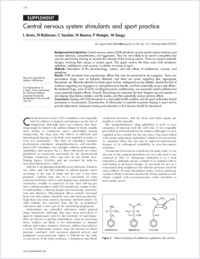
Central nervous system stimulants and sport practice.
- Avois L Swiss Laboratory for Doping Analyses, Lausanne University, Switzerland. lidia.avois@chuv.ch
- Robinson N
- Saudan C
- Baume N
- Mangin P
- Saugy M
- 2006-06-27
Published in:
- British journal of sports medicine. - 2006
Amphetamine
Central Nervous System Stimulants
Cocaine
Dopamine Uptake Inhibitors
Doping in Sports
Ephedrine
Humans
Sports
English
BACKGROUND AND OBJECTIVES
Central nervous system (CNS) stimulants may be used to reduce tiredness and increase alertness, competitiveness, and aggression. They are more likely to be used in competition but may be used during training to increase the intensity of the training session. There are several potential dangers involving their misuse in contact sports. This paper reviews the three main CNS stimulants, ephedrine, amfetamine, and cocaine, in relation to misuse in sport.
METHODS
Description of the pharmacology, actions, and side effects of amfetamine, cocaine, and ephedrine.
RESULTS
CNS stimulants have psychotropic effects that may be perceived to be ergogenic. Some are prescription drugs, such as Ephedra alkaloids, and there are issues regarding their appropriate therapeutic use. Recently attention has been given to their widespread use by athletes, despite the lack of evidence regarding any ergogenic or real performance benefit, and their potentially serious side effects. Recreational drugs, some of which are illegal (cocaine, amfetamines), are commonly used by athletes and cause potential ergolytic effects. Overall, these drugs are important for their frequent use and mention in anti-doping laboratories statistics and the media, and their potentially serious adverse effects.
CONCLUSIONS
Doping with CNS stimulants is a real public health problem and all sports authorities should participate in its prevention. Dissemination of information is essential to prevent doping in sport and to provide alternatives. Adequate training and education in this domain should be introduced.
Central nervous system (CNS) stimulants may be used to reduce tiredness and increase alertness, competitiveness, and aggression. They are more likely to be used in competition but may be used during training to increase the intensity of the training session. There are several potential dangers involving their misuse in contact sports. This paper reviews the three main CNS stimulants, ephedrine, amfetamine, and cocaine, in relation to misuse in sport.
METHODS
Description of the pharmacology, actions, and side effects of amfetamine, cocaine, and ephedrine.
RESULTS
CNS stimulants have psychotropic effects that may be perceived to be ergogenic. Some are prescription drugs, such as Ephedra alkaloids, and there are issues regarding their appropriate therapeutic use. Recently attention has been given to their widespread use by athletes, despite the lack of evidence regarding any ergogenic or real performance benefit, and their potentially serious side effects. Recreational drugs, some of which are illegal (cocaine, amfetamines), are commonly used by athletes and cause potential ergolytic effects. Overall, these drugs are important for their frequent use and mention in anti-doping laboratories statistics and the media, and their potentially serious adverse effects.
CONCLUSIONS
Doping with CNS stimulants is a real public health problem and all sports authorities should participate in its prevention. Dissemination of information is essential to prevent doping in sport and to provide alternatives. Adequate training and education in this domain should be introduced.
- Language
-
- English
- Open access status
- green
- Identifiers
-
- DOI 10.1136/bjsm.2006.027557
- PMID 16799095
- Persistent URL
- https://sonar.ch/global/documents/290652
Export to…
Statistics
Document views: 53
File downloads:
- Full-text: 0