Molecular Basis of the Rapamycin Insensitivity of Target Of Rapamycin Complex 2.
- Gaubitz C Department of Molecular Biology and Institute of Genetics and Genomics of Geneva (iGE3), University of Geneva, 30 Quai Ernest Ansermet, CH1211 Geneva, Switzerland.
- Oliveira TM European Molecular Biology Laboratory, Grenoble Outstation, 71 Avenue des Martyrs, 38042 Grenoble, France; Fondation ARC, 9 rue Guy Môquet, BP 90003, 04803 Villejuif Cedex, France.
- Prouteau M Department of Molecular Biology and Institute of Genetics and Genomics of Geneva (iGE3), University of Geneva, 30 Quai Ernest Ansermet, CH1211 Geneva, Switzerland.
- Leitner A Department of Biology, Institute of Molecular Systems Biology, ETH Zürich, 8093 Zürich, Switzerland.
- Karuppasamy M European Molecular Biology Laboratory, Grenoble Outstation, 71 Avenue des Martyrs, 38042 Grenoble, France.
- Konstantinidou G Department of Molecular Biology and Institute of Genetics and Genomics of Geneva (iGE3), University of Geneva, 30 Quai Ernest Ansermet, CH1211 Geneva, Switzerland.
- Rispal D Department of Molecular Biology and Institute of Genetics and Genomics of Geneva (iGE3), University of Geneva, 30 Quai Ernest Ansermet, CH1211 Geneva, Switzerland.
- Eltschinger S Department of Molecular Biology and Institute of Genetics and Genomics of Geneva (iGE3), University of Geneva, 30 Quai Ernest Ansermet, CH1211 Geneva, Switzerland.
- Robinson GC Department of Molecular Biology and Institute of Genetics and Genomics of Geneva (iGE3), University of Geneva, 30 Quai Ernest Ansermet, CH1211 Geneva, Switzerland.
- Thore S Department of Molecular Biology and Institute of Genetics and Genomics of Geneva (iGE3), University of Geneva, 30 Quai Ernest Ansermet, CH1211 Geneva, Switzerland; University of Bordeaux, European Institute for Chemistry and Biology, ARNA Laboratory, F-33607 Pessac, France; Institut National de la Santé Et de la Recherche Médicale, INSERM-U869, ARNA Laboratory, F-33000, Bordeaux, France.
- Aebersold R Department of Biology, Institute of Molecular Systems Biology, ETH Zürich, 8093 Zürich, Switzerland; Faculty of Science, University of Zürich, 8057 Zürich, Switzerland.
- Schaffitzel C European Molecular Biology Laboratory, Grenoble Outstation, 71 Avenue des Martyrs, 38042 Grenoble, France; School of Biochemistry, University of Bristol, Bristol, BS8 1TD, United Kingdom. Electronic address: schaffitzel@embl.fr.
- Loewith R Department of Molecular Biology and Institute of Genetics and Genomics of Geneva (iGE3), University of Geneva, 30 Quai Ernest Ansermet, CH1211 Geneva, Switzerland; National Centre of Competence in Research "Chemical Biology," University of Geneva, Geneva CH-1211, Switzerland. Electronic address: robbie.loewith@unige.ch.
- 2015-06-02
Published in:
- Molecular cell. - 2015
Antifungal Agents
Binding Sites
Biocatalysis
Blotting, Western
Carrier Proteins
Cell Cycle
Cell Cycle Proteins
Drug Resistance
Mass Spectrometry
Mechanistic Target of Rapamycin Complex 2
Microscopy, Electron
Multiprotein Complexes
Mutation
Phosphatidylinositol 3-Kinases
Protein Structure, Tertiary
Saccharomyces cerevisiae
Saccharomyces cerevisiae Proteins
Sirolimus
TOR Serine-Threonine Kinases
English
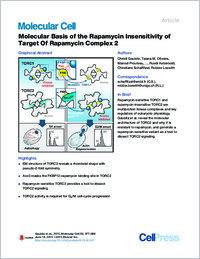
Target of Rapamycin (TOR) plays central roles in the regulation of eukaryote growth as the hub of two essential multiprotein complexes: TORC1, which is rapamycin-sensitive, and the lesser characterized TORC2, which is not. TORC2 is a key regulator of lipid biosynthesis and Akt-mediated survival signaling. In spite of its importance, its structure and the molecular basis of its rapamycin insensitivity are unknown. Using crosslinking-mass spectrometry and electron microscopy, we determined the architecture of TORC2. TORC2 displays a rhomboid shape with pseudo-2-fold symmetry and a prominent central cavity. Our data indicate that the C-terminal part of Avo3, a subunit unique to TORC2, is close to the FKBP12-rapamycin-binding domain of Tor2. Removal of this sequence generated a FKBP12-rapamycin-sensitive TORC2 variant, which provides a powerful tool for deciphering TORC2 function in vivo. Using this variant, we demonstrate a role for TORC2 in G2/M cell-cycle progression.
- Language
-
- English
- Open access status
- bronze
- Identifiers
-
- DOI 10.1016/j.molcel.2015.04.031
- PMID 26028537
- Persistent URL
- https://sonar.ch/global/documents/293540
Statistics
Document views: 93
File downloads:
- Full-text: 0