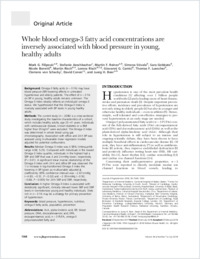
Whole blood omega-3 fatty acid concentrations are inversely associated with blood pressure in young, healthy adults.
- Filipovic MG Department of Internal Medicine, Cantonal Hospital of Baden, Baden.
- Aeschbacher S Division of Cardiology, Cardiovascular Research Institute Basel, University Hospital Basel, University of Basel, Basel, Switzerland.
- Reiner MF Department of Internal Medicine, Cantonal Hospital of Baden, Baden.
- Stivala S Center for Molecular Cardiology, University of Zurich, Zurich.
- Gobbato S Center for Molecular Cardiology, University of Zurich, Zurich.
- Bonetti N Center for Molecular Cardiology, University of Zurich, Zurich.
- Risch M Labormedizinisches Zentrum Dr Risch, Vaduz, Liechtenstein.
- Risch L Labormedizinisches Zentrum Dr Risch, Vaduz, Liechtenstein.
- Camici GG Center for Molecular Cardiology, University of Zurich, Zurich.
- Luescher TF Department of Cardiology, Royal Brompton & Harefield Hospitals, Imperial College, London, UK.
- von Schacky C Department of Preventive Cardiology, Ludwig-Maximilians University, Munich, Germany.
- Conen D Division of Cardiology, Cardiovascular Research Institute Basel, University Hospital Basel, University of Basel, Basel, Switzerland.
- Beer JH Department of Internal Medicine, Cantonal Hospital of Baden, Baden.
- 2018-03-24
Published in:
- Journal of hypertension. - 2018
Adult
Blood Pressure
Cohort Studies
Cross-Sectional Studies
Fatty Acids, Omega-3
Female
Healthy Volunteers
Humans
Male
English
BACKGROUND
Omega-3 fatty acids (n - 3 FA) may have blood pressure (BP)-lowering effects in untreated hypertensive and elderly patients. The effect of n - 3 FA on BP in young, healthy adults remains unknown. The Omega-3 Index reliably reflects an individuals' omega-3 status. We hypothesized that the Omega-3 Index is inversely associated with BP levels in young healthy adults.
METHODS
The current study (n = 2036) is a cross-sectional study investigating the baseline characteristics of a cohort, which includes healthy adults, age 25-41 years. Individuals with cardiovascular disease, known diabetes or a BMI higher than 35 kg/m were excluded. The Omega-3 Index was determined in whole blood using gas chromatography. Association with office and 24-h BP was assessed using multivariable linear regression models adjusted for potential confounders.
RESULTS
Median Omega-3 Index was 4.58% (interquartile range 4.08; 5.25). Compared with individuals in the lowest Omega-3 Index quartile, individuals in the highest had a SBP and DBP that was 4 and 2 mmHg lower, respectively (P < 0.01). A significant linear inverse relationship of the Omega-3 Index with 24-h and office BP was observed. Per 1-U increase in log-transformed Omega-3 Index the lowering in BP (given as multivariable adjusted β coefficients; 95% confidence interval) was -2.67 mmHg (-4.83; -0.51; P = 0.02) and -2.30 mmHg (-3.92; -0.68; P = 0.005) for 24-h SBP and DBP, respectively.
CONCLUSION
A higher Omega-3 Index is associated with statistically significant, clinically relevant lower SBP and DBP levels in normotensive young and healthy individuals. Diets rich in n - 3 FA may be a strategy for primary prevention of hypertension.
Omega-3 fatty acids (n - 3 FA) may have blood pressure (BP)-lowering effects in untreated hypertensive and elderly patients. The effect of n - 3 FA on BP in young, healthy adults remains unknown. The Omega-3 Index reliably reflects an individuals' omega-3 status. We hypothesized that the Omega-3 Index is inversely associated with BP levels in young healthy adults.
METHODS
The current study (n = 2036) is a cross-sectional study investigating the baseline characteristics of a cohort, which includes healthy adults, age 25-41 years. Individuals with cardiovascular disease, known diabetes or a BMI higher than 35 kg/m were excluded. The Omega-3 Index was determined in whole blood using gas chromatography. Association with office and 24-h BP was assessed using multivariable linear regression models adjusted for potential confounders.
RESULTS
Median Omega-3 Index was 4.58% (interquartile range 4.08; 5.25). Compared with individuals in the lowest Omega-3 Index quartile, individuals in the highest had a SBP and DBP that was 4 and 2 mmHg lower, respectively (P < 0.01). A significant linear inverse relationship of the Omega-3 Index with 24-h and office BP was observed. Per 1-U increase in log-transformed Omega-3 Index the lowering in BP (given as multivariable adjusted β coefficients; 95% confidence interval) was -2.67 mmHg (-4.83; -0.51; P = 0.02) and -2.30 mmHg (-3.92; -0.68; P = 0.005) for 24-h SBP and DBP, respectively.
CONCLUSION
A higher Omega-3 Index is associated with statistically significant, clinically relevant lower SBP and DBP levels in normotensive young and healthy individuals. Diets rich in n - 3 FA may be a strategy for primary prevention of hypertension.
- Language
-
- English
- Open access status
- green
- Identifiers
-
- DOI 10.1097/HJH.0000000000001728
- PMID 29570511
- Persistent URL
- https://sonar.ch/global/documents/30285
Statistics
Document views: 25
File downloads:
- Full-text: 0