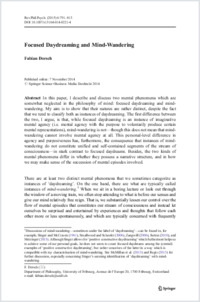
Focused Daydreaming and Mind-Wandering
csal
- Dorsch, Fabian Department of Philosophy, University of Fribourg, Avenue de l'Europe 20, 1700, Fribourg, Switzerland
-
2015
Published in:
- Review of Philosophy and Psychology. - Springer Netherlands. - 2015, vol. 6, no. 4, p. 791-813
English
In this paper, I describe and discuss two mental phenomena which are somewhat neglected in the philosophy of mind: focused daydreaming and mind-wandering. My aim is to show that their natures are rather distinct, despite the fact that we tend to classify both as instances of daydreaming. The first difference between the two, I argue, is that, while focused daydreaming is an instance of imaginative mental agency (i.e. mental agency with the purpose to voluntarily produce certain mental representations), mind-wandering is not—though this does not mean that mind-wandering cannot involve mental agency at all. This personal-level difference in agency and purposiveness has, furthermore, the consequence that instances of mind-wandering do not constitute unified and self-contained segments of the stream of consciousness—in stark contrast to focused daydreams. Besides, the two kinds of mental phenomena differ in whether they possess a narrative structure, and in how we may make sense of the succession of mental episodes involved.
- Collections
- Language
-
- English
- Classification
- Medicine
- License
-
License undefinedSpringer Science+Business Media Dordrecht, 2014
- Identifiers
-
- RERO DOC 331670
- SWISSBIB (NATIONALLICENCE)springer-10.1007/s13164-014-0221-4
- DOI 10.1007/s13164-014-0221-4
- Persistent URL
- https://sonar.ch/global/documents/309272
Statistics
Document views: 47
File downloads:
- Fulltext: 0