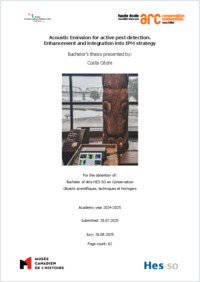
Acoustic Emission for active pest detection : Enhancement and integration into IPM strategy
SONAR|HES-SO
- Haute Ecole Arc Conservation-restauration ; Neuchâtel
135 p.
Bachelors of Arts HES-SO en Conservation: Haute Ecole Arc Conservation-restauration, 2025
English
French
German
Italian
Pest infestation represents a significant threat to heritage collections, with woodboring and
keratinophagous insect being particularly destructive. Conventional detection methods such as quarantine or sticky traps are time-consuming, provide limited information and can lead to unnecessary preventive treatment, generating important costs. This research investigates the use of Acoustic Emission (AE) as a non-invasive technique to detect active infestation in heritage collections, while enhancing the Integrated Pest Management (IPM) strategy of the Canadian Museum of History (CMH), following the recent ban of CO2 treatment that was previously used.
This study includes three major components:
- Collecting a dataset of AE signals from both infested and non-infested wooden samples to support artificial intelligence (AI)-based classification (parallel Bachelor thesis conducted by Tom Marti, engineering student at Haute Ecole Arc, Switzerland)
- Exploring the feasibility of extending AE to other organic objects such as books and textiles.
- Develops practical tools for IPM, including automated heatmap for pest tracking and AE testing protocol Laboratory and in-situ experiments were conducted using Vallen® AE equipment. Coupling material used are renaissance wax, solvent-free spray cyclododecane (CDD) and non-chemical method such as clamps or ribbons.
Results confirmed the great efficiency of AE for detecting woodboring activity, due, among other factors, to the low attenuation in wooden artefacts. Conversely, attenuation in textiles and paper was found to be too high for reliable monitoring, with the current setups tested. Additional findings highlight the impact of surface shape, grain orientation, coupling methods and wood moisture content on AE signals transmission.
While AE shows strong results on wooden artefacts and is already used in some institutions, the current state of the research does not provide sufficient conclusive data for recommending the extension of the technology to softer and more porous material. Nevertheless, this study introduces news elements and perspectives that could serves as foundation for future research. Les infestations d’insectes, en particulier les xylophages et kératinophages, représentent une importante menace pour les collections patrimoniales. Les méthodes de détection conventionnelles telles que la mise en quarantaine ou les pièges collants sont souvent chronophages et fournissent des informations limitées. Cela peut conduire à entreprendre des traitements préventifs sur des objets pour lesquels cela
n’aurait pas été nécessaire, entrainant des coûts importants. Ce travail se penche sur l’utilisation de
l’émission acoustique (EA) comme technique non-invasive pour la détection des infestations actives
dans les collections patrimoniales, tout en renforçant la stratégie de gestion intégrée des ravageurs (IPM) du Musée Canadien de l’Histoire, à la suite de l’interdiction récente de l’utilisation des traitements au CO2, précédemment utilisé, sur le territoire.
Cette étude comprend trois axes principaux :
- Constituer une base de données d’émissions acoustiques sur des échantillons de bois infestés et sain, dans le but de permettre une classification des signaux par intelligence artificielle (travail de
Bachelor parallèle réalisé par Tom Marti, étudiant en ingénierie à la Haute Ecole Arc, Suisse).
- Explorer la faisabilité de l’utilisation de l’émission acoustique à d’autres objets organiques tels que
les livres et les textiles.
- Développer des outils pratiques pour améliorer la stratégie IPM du musée, comme une carte
thermique automatisée permettant le suivi des nuisibles trouvés dans les pièges ainsi que des
protocoles détaillés pour utiliser l’EA au sein du musée.
Les expériences ont été réalisées avec l’équipement d’émission acoustique de l’entreprise Vallen®. Les matériaux couplants utilisés sont la cire Renaissance® , le cyclododécane (CDD) sans solvant en spray ainsi que des méthodes n’incluant pas l’ajout de produits, comme des serre-joints ou des rubans.
Les résultats confirment l’efficacité pour la détection des infestations dans les objets en bois, due notamment à la faible atténuation dans les artefacts. A l’inverse, l’atténuation dans les textiles et le papier s’est révélée trop élevée pour permettre un monitoring fiable, malgré les différentes configurations testées.
D’autres résultats mettent en évidence l’influence de la forme de l’objet, de l’orientation des fibres, des méthodes de couplage ou encore le taux d’humidité du bois sur la transmission des signaux d’EA.
Bien que l’émission acoustique donne des résultats probants sur les artefacts en bois et peut être recommandée au musée dans le cadre de sa stratégie IPM, l’état actuel de la recherche ne permet pas de faire la même recommandation concernant les matériaux organiques plus mous et poreux. Néanmoins, cette étude introduit de nouveaux éléments et perspectives, qui pourraient constituer un point de départ pour de futures recherches Schädlingsbefall stellt eine erhebliche Bedrohung für Kulturgutsammlungen dar, wobei holzbohrende und keratinophile Insekten besonders zerstörerisch sind. Herkömmliche Nachweismethoden wie Quarantäne oder Klebefallen sind zeitaufwändig, liefern nur begrenzte Informationen und können zu
unnötigen vorbeugenden Behandlungen führen, die erhebliche Kosten verursachen. Diese
Forschungsarbeit untersucht den Einsatz von Akustikemissionen (AE) als nicht-invasive Technik zur Erkennung von aktivem Befall in Kulturgütern und verbessert gleichzeitig die integrierte
Schädlingsbekämpfungsstrategie (IPM) des Canadian Museum of History (CMH) nach dem neuen Verbot der zuvor verwendeten CO2-Behandlung.
Diese Studie umfasst drei Haupkomponenten:
- Erfassung eines Datensatzes von AE-Signalen aus befallenen und nicht befallenen Holzproben zur Unterstützung der Klassifizierung auf Basis künstlicher Intelligenz (KI) (parallele Bachelorarbeit von Tom Marti, Ingenieurstudent an der Haute Ecole Arc, Schweiz).
- Untersuchung der Machbarkeit einer Ausweitung von AE auf andere organische Objekt wie Bücher
und Textilien.
- Entwicklung praktischer Tools für IPM, einschließlich einer automatisierten Heatmap zur
Schädlingsverfolgung und eines AE-Testprotokolls
Labor- und In-situ-Experimente wurden mit Vallen® AE-Geräten durchgeführt. Als Kopplungsmaterial wurden Renaissance®-Wachs, lösungsmittelfreies Sprühzyklododecan und nicht-chemische Methoden wie Klammern oder Bänder verwendet.
Die Ergebnisse bestätigten die hohe Effizienz von AE bei der Erkennung von Holzbohraktivitäten, unter anderem aufgrund der geringen Dämpfung in Holzartefakten. Umgekehrt wurde festgestellt, dass die Dämpfung in Textilien und Papier für eine zuverlässige Überwachung mit den derzeit getesteten Aufbauten zu hoch ist.
Weitere Ergebnisse unterstreichen den Einfluss der Oberflächenform, der Maserungsausrichtung, der Kopplungsmethoden und des Holzfeuchtegehalts auf die Übertragung von AE-Signalen.
Während AE bei Holzartefakten gute Ergebnisse liefert und bereits in einigen Einrichtungen eingesetzt wird, liefert der aktuelle Stand der Forschung keine ausreichenden schlüssigen Daten, um eine Ausweitung der Technologie auf weichere und porösere Materialien zu empfehlen. Dennoch liefert diese Studie neue Elemente und Perspektiven, die als Grundlage für zukünftige Forschungen dienen könnten. L’infestazione da parassiti rappresenta una minaccia significativa per le collezioni del patrimonio culturale, con insetti xyilofagi e cheratinofagi particolarmente distruttivi. I metodi di rilevamento convenzionali, come la quarantena o le trappole adesive, richiedono molto tempo, forniscono informazioni limitate e possono portare a trattamenti preventivi non necessari, generando costi importanti. Questa ricerca studia l’uso dell’emissione acustica (EA) come tecnica non invasiva per rilevare infestazioni attive nelle collezioni del patrimonio culturale, migliorando al contempo la strategia di gestione intergrata dei parassiti (IPM) del Canadian Museum of History (CMH), a seguito del recente divieto di utilizzo delle trattamento con CO2, precendentemente utilizzate.
Questo studio comprende tre componenti principali :
- Raccolta di un set di dati di segnali acustici EA da campioni di legno infestati e non infestati a
supporto della classificazione basata sull’intelligenza artificiale (IA) (tesi di laurea parallela condotta da Tom marti, studente di ingegneria presso la Haute Ecole Arc, Svizzera)
- Esplorazione della fattibilità di estendere l’EA ad altri oggetti organici come libri e tessuti.
- Sviluppo di strumenti pratici per l’IPM del museo, tra cui una mappa termica automatizzata per il
monitoraggio dei parassiti ritrovati nelle trappole e un protocolllo di test AE.
Gli esperimenti di laboratorio e in situ sono stati condotti utilizzando apparecchiature EA Vallen®. I
materiali di accoppiamento utilizzati sono cera Renaissance®, ciclododecano spray senza solventi (CDD)
e metodi non chimici come morsetti o nastri.
I risultati hanno confermato la grande efficienza dell'EA nel rilevare l'attività dei tarli, grazie, tra l'altro, alla bassa attenuazione nei manufatti in legno. Al contrario, l'attenuazione nei tessuti e nella carta è risultata troppo elevata per un monitoraggio affidabile, con le attuali configurazioni testate.
Ulteriori risultati evidenziano l'impatto della forma della superficie, dell'orientamento delle fibre, dei
metodi di accoppiamento e del contenuto di umidità del legno sulla trasmissione dei segnali EA.
Sebbene l’EA mostri risultati positivi sui manufatti in legno e sia già utilizzato in alcune istituzioni, lo
stato attuale della ricerca non fornisce dati conclusivi sufficienti per raccomandare l'estensione della tecnologia a materiali più morbidi e porosi. Tuttavia, questo studio introduce nuovi elementi e prospettive che potrebbero servire come base per ricerche future.
keratinophagous insect being particularly destructive. Conventional detection methods such as quarantine or sticky traps are time-consuming, provide limited information and can lead to unnecessary preventive treatment, generating important costs. This research investigates the use of Acoustic Emission (AE) as a non-invasive technique to detect active infestation in heritage collections, while enhancing the Integrated Pest Management (IPM) strategy of the Canadian Museum of History (CMH), following the recent ban of CO2 treatment that was previously used.
This study includes three major components:
- Collecting a dataset of AE signals from both infested and non-infested wooden samples to support artificial intelligence (AI)-based classification (parallel Bachelor thesis conducted by Tom Marti, engineering student at Haute Ecole Arc, Switzerland)
- Exploring the feasibility of extending AE to other organic objects such as books and textiles.
- Develops practical tools for IPM, including automated heatmap for pest tracking and AE testing protocol Laboratory and in-situ experiments were conducted using Vallen® AE equipment. Coupling material used are renaissance wax, solvent-free spray cyclododecane (CDD) and non-chemical method such as clamps or ribbons.
Results confirmed the great efficiency of AE for detecting woodboring activity, due, among other factors, to the low attenuation in wooden artefacts. Conversely, attenuation in textiles and paper was found to be too high for reliable monitoring, with the current setups tested. Additional findings highlight the impact of surface shape, grain orientation, coupling methods and wood moisture content on AE signals transmission.
While AE shows strong results on wooden artefacts and is already used in some institutions, the current state of the research does not provide sufficient conclusive data for recommending the extension of the technology to softer and more porous material. Nevertheless, this study introduces news elements and perspectives that could serves as foundation for future research. Les infestations d’insectes, en particulier les xylophages et kératinophages, représentent une importante menace pour les collections patrimoniales. Les méthodes de détection conventionnelles telles que la mise en quarantaine ou les pièges collants sont souvent chronophages et fournissent des informations limitées. Cela peut conduire à entreprendre des traitements préventifs sur des objets pour lesquels cela
n’aurait pas été nécessaire, entrainant des coûts importants. Ce travail se penche sur l’utilisation de
l’émission acoustique (EA) comme technique non-invasive pour la détection des infestations actives
dans les collections patrimoniales, tout en renforçant la stratégie de gestion intégrée des ravageurs (IPM) du Musée Canadien de l’Histoire, à la suite de l’interdiction récente de l’utilisation des traitements au CO2, précédemment utilisé, sur le territoire.
Cette étude comprend trois axes principaux :
- Constituer une base de données d’émissions acoustiques sur des échantillons de bois infestés et sain, dans le but de permettre une classification des signaux par intelligence artificielle (travail de
Bachelor parallèle réalisé par Tom Marti, étudiant en ingénierie à la Haute Ecole Arc, Suisse).
- Explorer la faisabilité de l’utilisation de l’émission acoustique à d’autres objets organiques tels que
les livres et les textiles.
- Développer des outils pratiques pour améliorer la stratégie IPM du musée, comme une carte
thermique automatisée permettant le suivi des nuisibles trouvés dans les pièges ainsi que des
protocoles détaillés pour utiliser l’EA au sein du musée.
Les expériences ont été réalisées avec l’équipement d’émission acoustique de l’entreprise Vallen®. Les matériaux couplants utilisés sont la cire Renaissance® , le cyclododécane (CDD) sans solvant en spray ainsi que des méthodes n’incluant pas l’ajout de produits, comme des serre-joints ou des rubans.
Les résultats confirment l’efficacité pour la détection des infestations dans les objets en bois, due notamment à la faible atténuation dans les artefacts. A l’inverse, l’atténuation dans les textiles et le papier s’est révélée trop élevée pour permettre un monitoring fiable, malgré les différentes configurations testées.
D’autres résultats mettent en évidence l’influence de la forme de l’objet, de l’orientation des fibres, des méthodes de couplage ou encore le taux d’humidité du bois sur la transmission des signaux d’EA.
Bien que l’émission acoustique donne des résultats probants sur les artefacts en bois et peut être recommandée au musée dans le cadre de sa stratégie IPM, l’état actuel de la recherche ne permet pas de faire la même recommandation concernant les matériaux organiques plus mous et poreux. Néanmoins, cette étude introduit de nouveaux éléments et perspectives, qui pourraient constituer un point de départ pour de futures recherches Schädlingsbefall stellt eine erhebliche Bedrohung für Kulturgutsammlungen dar, wobei holzbohrende und keratinophile Insekten besonders zerstörerisch sind. Herkömmliche Nachweismethoden wie Quarantäne oder Klebefallen sind zeitaufwändig, liefern nur begrenzte Informationen und können zu
unnötigen vorbeugenden Behandlungen führen, die erhebliche Kosten verursachen. Diese
Forschungsarbeit untersucht den Einsatz von Akustikemissionen (AE) als nicht-invasive Technik zur Erkennung von aktivem Befall in Kulturgütern und verbessert gleichzeitig die integrierte
Schädlingsbekämpfungsstrategie (IPM) des Canadian Museum of History (CMH) nach dem neuen Verbot der zuvor verwendeten CO2-Behandlung.
Diese Studie umfasst drei Haupkomponenten:
- Erfassung eines Datensatzes von AE-Signalen aus befallenen und nicht befallenen Holzproben zur Unterstützung der Klassifizierung auf Basis künstlicher Intelligenz (KI) (parallele Bachelorarbeit von Tom Marti, Ingenieurstudent an der Haute Ecole Arc, Schweiz).
- Untersuchung der Machbarkeit einer Ausweitung von AE auf andere organische Objekt wie Bücher
und Textilien.
- Entwicklung praktischer Tools für IPM, einschließlich einer automatisierten Heatmap zur
Schädlingsverfolgung und eines AE-Testprotokolls
Labor- und In-situ-Experimente wurden mit Vallen® AE-Geräten durchgeführt. Als Kopplungsmaterial wurden Renaissance®-Wachs, lösungsmittelfreies Sprühzyklododecan und nicht-chemische Methoden wie Klammern oder Bänder verwendet.
Die Ergebnisse bestätigten die hohe Effizienz von AE bei der Erkennung von Holzbohraktivitäten, unter anderem aufgrund der geringen Dämpfung in Holzartefakten. Umgekehrt wurde festgestellt, dass die Dämpfung in Textilien und Papier für eine zuverlässige Überwachung mit den derzeit getesteten Aufbauten zu hoch ist.
Weitere Ergebnisse unterstreichen den Einfluss der Oberflächenform, der Maserungsausrichtung, der Kopplungsmethoden und des Holzfeuchtegehalts auf die Übertragung von AE-Signalen.
Während AE bei Holzartefakten gute Ergebnisse liefert und bereits in einigen Einrichtungen eingesetzt wird, liefert der aktuelle Stand der Forschung keine ausreichenden schlüssigen Daten, um eine Ausweitung der Technologie auf weichere und porösere Materialien zu empfehlen. Dennoch liefert diese Studie neue Elemente und Perspektiven, die als Grundlage für zukünftige Forschungen dienen könnten. L’infestazione da parassiti rappresenta una minaccia significativa per le collezioni del patrimonio culturale, con insetti xyilofagi e cheratinofagi particolarmente distruttivi. I metodi di rilevamento convenzionali, come la quarantena o le trappole adesive, richiedono molto tempo, forniscono informazioni limitate e possono portare a trattamenti preventivi non necessari, generando costi importanti. Questa ricerca studia l’uso dell’emissione acustica (EA) come tecnica non invasiva per rilevare infestazioni attive nelle collezioni del patrimonio culturale, migliorando al contempo la strategia di gestione intergrata dei parassiti (IPM) del Canadian Museum of History (CMH), a seguito del recente divieto di utilizzo delle trattamento con CO2, precendentemente utilizzate.
Questo studio comprende tre componenti principali :
- Raccolta di un set di dati di segnali acustici EA da campioni di legno infestati e non infestati a
supporto della classificazione basata sull’intelligenza artificiale (IA) (tesi di laurea parallela condotta da Tom marti, studente di ingegneria presso la Haute Ecole Arc, Svizzera)
- Esplorazione della fattibilità di estendere l’EA ad altri oggetti organici come libri e tessuti.
- Sviluppo di strumenti pratici per l’IPM del museo, tra cui una mappa termica automatizzata per il
monitoraggio dei parassiti ritrovati nelle trappole e un protocolllo di test AE.
Gli esperimenti di laboratorio e in situ sono stati condotti utilizzando apparecchiature EA Vallen®. I
materiali di accoppiamento utilizzati sono cera Renaissance®, ciclododecano spray senza solventi (CDD)
e metodi non chimici come morsetti o nastri.
I risultati hanno confermato la grande efficienza dell'EA nel rilevare l'attività dei tarli, grazie, tra l'altro, alla bassa attenuazione nei manufatti in legno. Al contrario, l'attenuazione nei tessuti e nella carta è risultata troppo elevata per un monitoraggio affidabile, con le attuali configurazioni testate.
Ulteriori risultati evidenziano l'impatto della forma della superficie, dell'orientamento delle fibre, dei
metodi di accoppiamento e del contenuto di umidità del legno sulla trasmissione dei segnali EA.
Sebbene l’EA mostri risultati positivi sui manufatti in legno e sia già utilizzato in alcune istituzioni, lo
stato attuale della ricerca non fornisce dati conclusivi sufficienti per raccomandare l'estensione della tecnologia a materiali più morbidi e porosi. Tuttavia, questo studio introduce nuovi elementi e prospettive che potrebbero servire come base per ricerche future.
- Language
-
- English
- Notes
-
- Haute Ecole Arc Conservation-restauration
- Orientation : objets scientifiques, techniques et horlogers
- hesso:hearc-cor
- Persistent URL
- https://sonar.ch/global/documents/333167
Export to…
Statistics
Document views: 453
File downloads:
- 2025_BA_CROSTH_Costa_Acoustic emission.pdf: 403