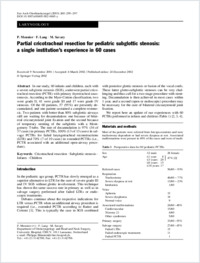
Partial cricotracheal resection for pediatric subglottic stenosis: a single institution's experience in 60 cases.
- 2003-08-09
Published in:
- European archives of oto-rhino-laryngology : official journal of the European Federation of Oto-Rhino-Laryngological Societies (EUFOS) : affiliated with the German Society for Oto-Rhino-Laryngology - Head and Neck Surgery. - 2003
Adolescent
Anastomosis, Surgical
Child
Child, Preschool
Cricoid Cartilage
Dyspnea
Female
Humans
Infant
Infant, Newborn
Laryngostenosis
Male
Reoperation
Thyroid Gland
Trachea
Treatment Outcome
English
In our study, 60 infants and children, each with a severe subglottic stenosis (SGS), underwent partial cricotracheal resection (PCTR) with primary thyrotracheal anastomosis. According to the Myer-Cotton classification, two were grade II, 41 were grade III and 17 were grade IV stenoses. Of the 60 patients, 57 (95%) are presently decannulated, and one patient sustained a complete restenosis. Two patients with better than 80% subglottic airways still are waiting for decannulation: one because of bilateral cricoarytenoid joint fixation and the second because of temporary stenting of the subglottis with a Montgomery T-tube. The rate of decannulation is 97% (36 of 37 cases) in primary PCTRs, 100% (13 of 13 cases) in salvage PCTRs for failed laryngotracheal reconstructions (LTR) and 70% (7 of 10 cases) in extended PCTRs (i.e., PCTR associated with an additional open-airway procedure).
- Language
-
- English
- Open access status
- green
- Identifiers
-
- DOI 10.1007/s00405-002-0465-y
- PMID 12904983
- Persistent URL
- https://sonar.ch/global/documents/35325
Export to…
Statistics
Document views: 60
File downloads:
- Full-text: 0