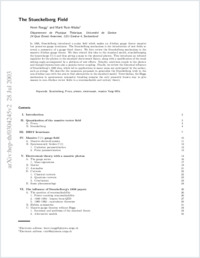
THE STUECKELBERG FIELD
- RUEGG, HENRI Département de Physique Théorique, Université de Genève, 24 Quai Ernest Ansermet, 1211 Genève 4, Switzerland
- RUIZ-ALTABA, MARTÍ Département de Physique Théorique, Université de Genève, 24 Quai Ernest Ansermet, 1211 Genève 4, Switzerland
- 2012-5-2
Published in:
- International Journal of Modern Physics A. - World Scientific Pub Co Pte Lt. - 2004, vol. 19, no. 20, p. 3265-3347
English
In 1938, Stueckelberg introduced a scalar field which makes an Abelian gauge theory massive but preserves gauge invariance. The Stueckelberg mechanism is the introduction of new fields to reveal a symmetry of a gauge-fixed theory. We first review the Stueckelberg mechanism in the massive Abelian gauge theory. We then extend this idea to the standard model, stueckelberging the hypercharge U(1) and thus giving a mass to the physical photon. This introduces an infrared regulator for the photon in the standard electroweak theory, along with a modification of the weak mixing angle accompanied by a plethora of new effects. Notably, neutrinos couple to the photon and charged leptons have also a pseudo-vector coupling. Finally, we review the historical influence of Stueckelberg's 1938 idea, which led to applications in many areas not anticipated by the author, such as strings. We describe the numerous proposals to generalize the Stueckelberg trick to the non-Abelian case with the aim to find alternatives to the standard model. Nevertheless, the Higgs mechanism in spontaneous symmetry breaking remains the only presently known way to give masses to non-Abelian vector fields in a renormalizable and unitary theory.
- Language
-
- English
- Open access status
- green
- Identifiers
-
- DOI 10.1142/s0217751x04019755
- ISSN 0217-751X
- Persistent URL
- https://sonar.ch/global/documents/42683
Export to…
Statistics
Document views: 119
File downloads:
- Full-text: 0