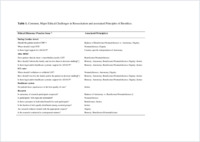
Ethical challenges in resuscitation.
- Mentzelopoulos SD First Department of Intensive Care Medicine, National and Kapodistrian University of Athens Medical School, Evaggelismos General Hospital, 45-47 Ipsilandou Street, 10675, Athens, Greece. sdmentzelopoulos@yahoo.com.
- Slowther AM Division of Health Sciences, Warwick Medical School, Gibbet Hill Campus, Coventry, CV4 7AL, UK.
- Fritz Z Acute Medicine, Cambridge University Hospitals NHS Foundation Trust, Cambridge, UK.
- Sandroni C Istituto Anestesiologia e Rianimazione, Università Cattolica del Sacro Cuore Fondazione Policlinico, Universitario Agostino Gemelli, Largo Francesco Vito 1, 00168, Rome, Italy.
- Xanthos T European University, Engomi, Cyprus.
- Callaway C University of Pittsburgh, Pittsburgh, PA, 15260, USA.
- Perkins GD Division of Health Sciences, Warwick Medical School, Gibbet Hill Campus, Coventry, CV4 7AL, UK.
- Newgard C Department of Emergency Medicine Oregon Health and Science University Portland, Center for Policy and Research in Emergency Medicine, Portland, OR, USA.
- Ischaki E First Department of Intensive Care Medicine, National and Kapodistrian University of Athens Medical School, Evaggelismos General Hospital, 45-47 Ipsilandou Street, 10675, Athens, Greece.
- Greif R Department of Anesthesiology and Pain Therapy, University of Bern, Bern University Hospital, 3010, Bern, Switzerland.
- Kompanje E Department of Intensive Care, Department of Ethics and Philosophy of Medicine, Erasmus MC University Medical Center, Rotterdam, The Netherlands.
- Bossaert L Faculty of Medicine and Health Sciences, University of Antwerp, Antwerp, Belgium.
- 2018-05-12
Published in:
- Intensive care medicine. - 2018
Beneficence
Personal autonomy
Resuscitation
Social justice
Beneficence
Decision Making
Humans
Medical Futility
Personal Autonomy
Resuscitation
English
PURPOSE
A rapidly evolving resuscitation science provides more effective treatments to an aging population with multiple comorbidites. Concurrently, emergency care has become patient-centered. This review aims to describe challenges associated with the application of key principles of bioethics in resuscitation and post-resuscitation care; propose actions to address these challenges; and highlight the need for evidence-based ethics and consensus on ethical principles interpretation.
METHODS
Following agreement on the article's outline, subgroups of 2-3 authors provided narrative reviews of ethical issues concerning autonomy and honesty, beneficence/nonmaleficence and dignity, justice, specific practices/circumstances such as family presence during resuscitation, and emergency research. Proposals for addressing ethical challenges were also offered.
RESULTS
Respect for patient autonomy can be realized through honest provision of information, shared decision-making, and advance directives/care planning. Essential prerequisites comprise public and specific healthcare professionals' education, appropriate regulatory provisions, and allocation of adequate resources. Regarding beneficence/nonmaleficence, resuscitation should benefit patients, while avoiding harm from futile interventions; pertinent practice should be based on neurological prognostication and patient/family-reported outcomes. Regarding dignity, aggressive life-sustaining treatments against patients preferences should be avoided. Contrary to the principle of justice, resuscitation quality may be affected by race/income status, age, ethnicity, comorbidity, and location (urban versus rural or country-specific/region-specific). Current evidence supports family presence during resuscitation. Regarding emergency research, autonomy should be respected without hindering scientific progress; furthermore, transparency of research conduct should be promoted and funding increased.
CONCLUSIONS
Major ethical challenges in resuscitation science need to be addressed through complex/resource-demanding interventions. Such actions require support by ongoing/future research.
- Language
-
- English
- Open access status
- green
- Identifiers
-
- DOI 10.1007/s00134-018-5202-0
- PMID 29748717
- Persistent URL
- https://sonar.ch/global/documents/44397
Export to…
Statistics
Document views: 89
File downloads:
- Full-text: 0