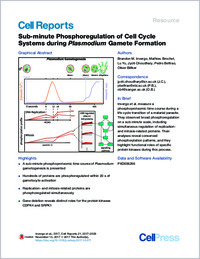
Sub-minute Phosphoregulation of Cell Cycle Systems during Plasmodium Gamete Formation.
- Invergo BM European Molecular Biology Laboratory, European Bioinformatics Institute (EMBL-EBI), Hinxton, Cambridgeshire CB10 1SD, UK; Malaria Programme, Wellcome Trust Sanger Institute, Hinxton, Cambridgeshire CB10 1SA, UK.
- Brochet M Malaria Programme, Wellcome Trust Sanger Institute, Hinxton, Cambridgeshire CB10 1SA, UK; Department of Microbiology & Molecular Medicine, CMU, University of Geneva, 1211 Geneva 4, Geneva, Switzerland.
- Yu L Proteomics Mass Spectrometry, Wellcome Trust Sanger Institute, Hinxton, Cambridgeshire CB10 1SA, UK; The Institute of Cancer Research, Chester Betty Laboratory, London, Greater London SW7 3RP, UK.
- Choudhary J Proteomics Mass Spectrometry, Wellcome Trust Sanger Institute, Hinxton, Cambridgeshire CB10 1SA, UK; The Institute of Cancer Research, Chester Betty Laboratory, London, Greater London SW7 3RP, UK. Electronic address: jyoti.choudhary@icr.ac.uk.
- Beltrao P European Molecular Biology Laboratory, European Bioinformatics Institute (EMBL-EBI), Hinxton, Cambridgeshire CB10 1SD, UK. Electronic address: pbeltrao@ebi.ac.uk.
- Billker O Malaria Programme, Wellcome Trust Sanger Institute, Hinxton, Cambridgeshire CB10 1SA, UK. Electronic address: ob4@sanger.ac.uk.
- 2017-11-16
Published in:
- Cell reports. - 2017
ARK2
CRK5
gametogenesis
proteomics
signal transduction
Animals
Cell Cycle
Female
Gametogenesis
Life Cycle Stages
Male
Mice
Phosphorylation
Plasmodium berghei
Protein Processing, Post-Translational
Protein-Serine-Threonine Kinases
Protozoan Proteins
Signal Transduction
English
The transmission of malaria parasites to mosquitoes relies on the rapid induction of sexual reproduction upon their ingestion into a blood meal. Haploid female and male gametocytes become activated and emerge from their host cells, and the males enter the cell cycle to produce eight microgametes. The synchronized nature of gametogenesis allowed us to investigate phosphorylation signaling during its first minute in Plasmodium berghei via a high-resolution time course of the phosphoproteome. This revealed an unexpectedly broad response, with proteins related to distinct cell cycle events undergoing simultaneous phosphoregulation. We implicate several protein kinases in the process, and we validate our analyses on the plant-like calcium-dependent protein kinase 4 (CDPK4) and a homolog of serine/arginine-rich protein kinases (SRPK1). Mutants in these kinases displayed distinct phosphoproteomic disruptions, consistent with differences in their phenotypes. The results reveal the central role of protein phosphorylation in the atypical cell cycle regulation of a divergent eukaryote.
- Language
-
- English
- Open access status
- gold
- Identifiers
-
- DOI 10.1016/j.celrep.2017.10.071
- PMID 29141230
- Persistent URL
- https://sonar.ch/global/documents/46488
Statistics
Document views: 50
File downloads:
- Full-text: 0