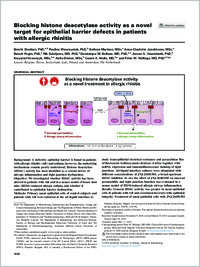
Blocking histone deacetylase activity as a novel target for epithelial barrier defects in patients with allergic rhinitis.
- Steelant B Department of Microbiology, Immunology and Transplantation, Allergy and Clinical Immunology Research Group, KU Leuven, Leuven, Belgium; Swiss Institute of Allergy and Asthma Research (SIAF), University of Zurich, Davos, Switzerland.
- Wawrzyniak P Swiss Institute of Allergy and Asthma Research (SIAF), University of Zurich, Davos, Switzerland.
- Martens K Department of Microbiology, Immunology and Transplantation, Allergy and Clinical Immunology Research Group, KU Leuven, Leuven, Belgium.
- Jonckheere AC Department of Microbiology, Immunology and Transplantation, Allergy and Clinical Immunology Research Group, KU Leuven, Leuven, Belgium.
- Pugin B Department of Microbiology, Immunology and Transplantation, Allergy and Clinical Immunology Research Group, KU Leuven, Leuven, Belgium.
- Schrijvers R Department of Microbiology, Immunology and Transplantation, Allergy and Clinical Immunology Research Group, KU Leuven, Leuven, Belgium.
- Bullens DM Department of Microbiology, Immunology and Transplantation, Allergy and Clinical Immunology Research Group, KU Leuven, Leuven, Belgium; Clinical Department of Pediatrics, Head and Neck Surgery, University Hospitals Leuven, Leuven, Belgium.
- Vanoirbeek JA Department of Public Health and Primary Care, Laboratory of Environment and Health, KU Leuven, Leuven, Belgium.
- Krawczyk K Swiss Institute of Allergy and Asthma Research (SIAF), University of Zurich, Davos, Switzerland; Department of Immunology and Infectious Biology, Faculty of Biology and Environmental Protection, University of Lodz, Lodz, Poland.
- Dreher A Swiss Institute of Allergy and Asthma Research (SIAF), University of Zurich, Davos, Switzerland.
- Akdis CA Swiss Institute of Allergy and Asthma Research (SIAF), University of Zurich, Davos, Switzerland.
- Hellings PW Department of Microbiology, Immunology and Transplantation, Allergy and Clinical Immunology Research Group, KU Leuven, Leuven, Belgium; Clinical Department of Otorhinolaryngology, Head and Neck Surgery, University Hospitals Leuven, Leuven, Belgium; Department of Otorhinolaryngology, Academic Medical Center, University of Amsterdam, Amsterdam, The Netherlands. Electronic address: Peter.hellings@kuleuven.be.
- 2019-05-15
Published in:
- The Journal of allergy and clinical immunology. - 2019
Allergic rhinitis
epigenetic changes
histone deacetylase
primary nasal epithelial cells
tight junctions
Animals
Antigens, Dermatophagoides
Asthma
Cells, Cultured
Disease Models, Animal
Histone Deacetylase Inhibitors
Histone Deacetylases
Humans
Hydroxamic Acids
Male
Mice
Mice, Inbred C57BL
Nasal Mucosa
Rhinitis, Allergic
Tight Junctions
English
BACKGROUND
A defective epithelial barrier is found in patients with allergic rhinitis (AR) and asthma; however, the underlying mechanisms remain poorly understood. Histone deacetylase (HDAC) activity has been identified as a crucial driver of allergic inflammation and tight junction dysfunction.
OBJECTIVE
We investigated whether HDAC activity has been altered in patients with AR and in a mouse model of house dust mite (HDM)-induced allergic asthma and whether it contributed to epithelial barrier dysfunction.
METHODS
Primary nasal epithelial cells of control subjects and patients with AR were cultured at the air-liquid interface to study transepithelial electrical resistance and paracellular flux of fluorescein isothiocyanate-dextran (4 kDa) together with mRNA expression and immunofluorescence staining of tight junctions. Air-liquid interface cultures were stimulated with different concentrations of JNJ-26481585, a broad-spectrum HDAC inhibitor. In vivo the effect of JNJ-26481585 on mucosal permeability and tight junction function was evaluated in a mouse model of HDM-induced allergic airway inflammation.
RESULTS
General HDAC activity was greater in nasal epithelial cells of patients with AR and correlated inversely with epithelial integrity. Treatment of nasal epithelial cells with JNJ-26481585 restored epithelial integrity by promoting tight junction expression and protein reorganization. HDM-sensitized mice were treated with JNJ-26481585 to demonstrate the in vivo role of HDACs. Treated mice did not have allergic airway inflammation and had no bronchial hyperreactivity. Moreover, JNJ-26481585 treatment restored nasal mucosal function by promoting tight junction expression.
CONCLUSION
Our findings identify increased HDAC activity as a potential tissue-injury mechanism responsible for dysregulated epithelial cell repair, leading to defective epithelial barriers in AR. Blocking HDAC activity is a promising novel target for therapeutic intervention in patients with airway diseases.
A defective epithelial barrier is found in patients with allergic rhinitis (AR) and asthma; however, the underlying mechanisms remain poorly understood. Histone deacetylase (HDAC) activity has been identified as a crucial driver of allergic inflammation and tight junction dysfunction.
OBJECTIVE
We investigated whether HDAC activity has been altered in patients with AR and in a mouse model of house dust mite (HDM)-induced allergic asthma and whether it contributed to epithelial barrier dysfunction.
METHODS
Primary nasal epithelial cells of control subjects and patients with AR were cultured at the air-liquid interface to study transepithelial electrical resistance and paracellular flux of fluorescein isothiocyanate-dextran (4 kDa) together with mRNA expression and immunofluorescence staining of tight junctions. Air-liquid interface cultures were stimulated with different concentrations of JNJ-26481585, a broad-spectrum HDAC inhibitor. In vivo the effect of JNJ-26481585 on mucosal permeability and tight junction function was evaluated in a mouse model of HDM-induced allergic airway inflammation.
RESULTS
General HDAC activity was greater in nasal epithelial cells of patients with AR and correlated inversely with epithelial integrity. Treatment of nasal epithelial cells with JNJ-26481585 restored epithelial integrity by promoting tight junction expression and protein reorganization. HDM-sensitized mice were treated with JNJ-26481585 to demonstrate the in vivo role of HDACs. Treated mice did not have allergic airway inflammation and had no bronchial hyperreactivity. Moreover, JNJ-26481585 treatment restored nasal mucosal function by promoting tight junction expression.
CONCLUSION
Our findings identify increased HDAC activity as a potential tissue-injury mechanism responsible for dysregulated epithelial cell repair, leading to defective epithelial barriers in AR. Blocking HDAC activity is a promising novel target for therapeutic intervention in patients with airway diseases.
- Language
-
- English
- Open access status
- bronze
- Identifiers
-
- DOI 10.1016/j.jaci.2019.04.027
- PMID 31082457
- Persistent URL
- https://sonar.ch/global/documents/47756
Statistics
Document views: 126
File downloads:
- Full-text: 0