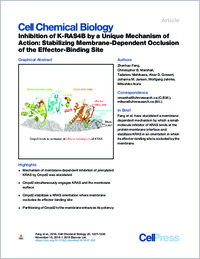
Inhibition of K-RAS4B by a Unique Mechanism of Action: Stabilizing Membrane-Dependent Occlusion of the Effector-Binding Site.
- Fang Z Department of Medical Biophysics, University of Toronto, Princess Margaret Cancer Centre, University Health Network, Toronto, ON M5G 2M9, Canada.
- Marshall CB Department of Medical Biophysics, University of Toronto, Princess Margaret Cancer Centre, University Health Network, Toronto, ON M5G 2M9, Canada. Electronic address: cmarshal@uhnresearch.ca.
- Nishikawa T Department of Medical Biophysics, University of Toronto, Princess Margaret Cancer Centre, University Health Network, Toronto, ON M5G 2M9, Canada.
- Gossert AD Chemical Biology and Therapeutics, Novartis Institutes for BioMedical Research, Basel 4002, Switzerland; Institute for Molecular Biology and Biophysics, Department of Biology, ETH Zürich, Zürich 8093, Switzerland.
- Jansen JM Department of Global Discovery Chemistry, Novartis Institutes for BioMedical Research, Emeryville, CA 94608, USA.
- Jahnke W Chemical Biology and Therapeutics, Novartis Institutes for BioMedical Research, Basel 4002, Switzerland.
- Ikura M Department of Medical Biophysics, University of Toronto, Princess Margaret Cancer Centre, University Health Network, Toronto, ON M5G 2M9, Canada. Electronic address: mikura@uhnresearch.ca.
- 2018-08-21
Published in:
- Cell chemical biology. - 2018
HADDOCK
KRAS
NMR
cancer
drug discovery
membrane-associated protein
nanodisc
paramagnetic relaxation enhancement
phospholipid bilayer
prenylation
Animals
Antineoplastic Agents
Drug Discovery
Enzyme Inhibitors
Humans
Indoles
Lipid Bilayers
Models, Molecular
Piperidines
Proto-Oncogene Proteins p21(ras)
English
KRAS is frequently mutated in several of the most lethal types of cancer; however, the KRAS protein has proven a challenging drug target. K-RAS4B must be localized to the plasma membrane by prenylation to activate oncogenic signaling, thus we endeavored to target the protein-membrane interface with small-molecule compounds. While all reported lead compounds have low affinity for KRAS in solution, the potency of Cmpd2 was strongly enhanced when prenylated K-RAS4B is associated with a lipid bilayer. We have elucidated a unique mechanism of action of Cmpd2, which simultaneously engages a shallow pocket on KRAS and associates with the lipid bilayer, thereby stabilizing KRAS in an orientation in which the membrane occludes its effector-binding site, reducing RAF binding and impairing activation of RAF. Furthermore, enrichment of Cmpd2 on the bilayer enhances potency by promoting interaction with KRAS. This insight reveals a novel approach to developing inhibitors of membrane-associated proteins.
- Language
-
- English
- Open access status
- bronze
- Identifiers
-
- DOI 10.1016/j.chembiol.2018.07.009
- PMID 30122370
- Persistent URL
- https://sonar.ch/global/documents/52443
Statistics
Document views: 23
File downloads:
- Full-text: 0