High-Power Growth-Robust InGaAs/InAlAs Terahertz Quantum Cascade Lasers.
- Deutsch C Photonics Institute, TU Wien, Gußhausstraße 27-29, 1040 Vienna, Austria.
- Kainz MA Photonics Institute, TU Wien, Gußhausstraße 27-29, 1040 Vienna, Austria.
- Krall M Photonics Institute, TU Wien, Gußhausstraße 27-29, 1040 Vienna, Austria.
- Brandstetter M Photonics Institute, TU Wien, Gußhausstraße 27-29, 1040 Vienna, Austria.
- Bachmann D Photonics Institute, TU Wien, Gußhausstraße 27-29, 1040 Vienna, Austria.
- Schönhuber S Photonics Institute, TU Wien, Gußhausstraße 27-29, 1040 Vienna, Austria.
- Detz H Institute of Solid State Electronics and Center for Micro- and Nanostructures, TU Wien, Floragasse 7, 1040 Vienna, Austria.
- Zederbauer T Institute of Solid State Electronics and Center for Micro- and Nanostructures, TU Wien, Floragasse 7, 1040 Vienna, Austria.
- MacFarland D Institute of Solid State Electronics and Center for Micro- and Nanostructures, TU Wien, Floragasse 7, 1040 Vienna, Austria.
- Andrews AM Institute of Solid State Electronics and Center for Micro- and Nanostructures, TU Wien, Floragasse 7, 1040 Vienna, Austria.
- Schrenk W Institute of Solid State Electronics and Center for Micro- and Nanostructures, TU Wien, Floragasse 7, 1040 Vienna, Austria.
- Beck M Institute for Quantum Electronics, ETH Zurich, Auguste-Piccard-Hof 1, 8093 Zurich, Switzerland.
- Ohtani K Institute for Quantum Electronics, ETH Zurich, Auguste-Piccard-Hof 1, 8093 Zurich, Switzerland.
- Faist J Institute for Quantum Electronics, ETH Zurich, Auguste-Piccard-Hof 1, 8093 Zurich, Switzerland.
- Strasser G Institute of Solid State Electronics and Center for Micro- and Nanostructures, TU Wien, Floragasse 7, 1040 Vienna, Austria.
- Unterrainer K Photonics Institute, TU Wien, Gußhausstraße 27-29, 1040 Vienna, Austria.
- 2017-05-05
Published in:
- ACS photonics. - 2017
low effective mass
molecular beam epitaxy
nanostructures
quantized transitions
quantum cascade lasers
terahertz
English
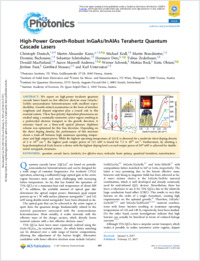
We report on high-power terahertz quantum cascade lasers based on low effective electron mass InGaAs/InAlAs semiconductor heterostructures with excellent reproducibility. Growth-related asymmetries in the form of interface roughness and dopant migration play a crucial role in this material system. These bias polarity dependent phenomena are studied using a nominally symmetric active region resulting in a preferential electron transport in the growth direction. A structure based on a three-well optical phonon depletion scheme was optimized for this bias direction. Depending on the sheet doping density, the performance of this structure shows a trade-off between high maximum operating temperature and high output power. While the highest operating temperature of 155 K is observed for a moderate sheet doping density of 2 × 1010 cm-2, the highest peak output power of 151 mW is found for 7.3 × 1010 cm-2. Furthermore, by abutting a hyperhemispherical GaAs lens to a device with the highest doping level a record output power of 587 mW is achieved for double-metal waveguide structures.
- Language
-
- English
- Open access status
- hybrid
- Identifiers
-
- DOI 10.1021/acsphotonics.7b00009
- PMID 28470028
- Persistent URL
- https://sonar.ch/global/documents/66735
Statistics
Document views: 58
File downloads:
- Full-text: 0