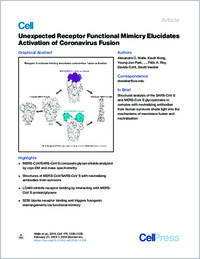
Unexpected Receptor Functional Mimicry Elucidates Activation of Coronavirus Fusion.
- Walls AC Department of Biochemistry, University of Washington, Seattle, Washington 98195, USA.
- Xiong X Department of Biochemistry, University of Washington, Seattle, Washington 98195, USA.
- Park YJ Department of Biochemistry, University of Washington, Seattle, Washington 98195, USA.
- Tortorici MA Department of Biochemistry, University of Washington, Seattle, Washington 98195, USA; Institute Pasteur & CNRS UMR 3569, Unité de Virologie Structurale, 75015, Paris, France.
- Snijder J Department of Biochemistry, University of Washington, Seattle, Washington 98195, USA.
- Quispe J Department of Biochemistry, University of Washington, Seattle, Washington 98195, USA.
- Cameroni E Humabs Biomed SA, Vir Biotechnology, 6500 Bellinzona, Switzerland.
- Gopal R National Infection Service, Public Health England, London NW9 5HT, UK.
- Dai M Crick Worldwide Influenza Centre, The Francis Crick Institute, 1 Midland Road, London NW1 1AT, UK.
- Lanzavecchia A Institute for Research in Biomedicine, Faculty of Biomedical Sciences, Università della Svizzera italiana, 6500 Bellinzona, Switzerland.
- Zambon M National Infection Service, Public Health England, London NW9 5HT, UK.
- Rey FA Institute Pasteur & CNRS UMR 3569, Unité de Virologie Structurale, 75015, Paris, France.
- Corti D Humabs Biomed SA, Vir Biotechnology, 6500 Bellinzona, Switzerland.
- Veesler D Department of Biochemistry, University of Washington, Seattle, Washington 98195, USA. Electronic address: dveesler@uw.edu.
- 2019-02-05
Published in:
- Cell. - 2019
MERS-CoV
N-linked glycosylation
SARS-CoV
class I fusion protein
coronavirus
glycoproteomics
membrane fusion
neutralizing antibodies
spike glycoprotein
Animals
Antibodies, Monoclonal
Antibodies, Neutralizing
Antibodies, Viral
Chlorocebus aethiops
Coronavirus
Coronavirus Infections
HEK293 Cells
Humans
Immunity, Humoral
Middle East Respiratory Syndrome Coronavirus
Molecular Mimicry
Protein Binding
Receptors, Virus
SARS Virus
Spike Glycoprotein, Coronavirus
Vero Cells
Virus Internalization
English
Recent outbreaks of severe acute respiratory syndrome and Middle East respiratory syndrome, along with the threat of a future coronavirus-mediated pandemic, underscore the importance of finding ways to combat these viruses. The trimeric spike transmembrane glycoprotein S mediates entry into host cells and is the major target of neutralizing antibodies. To understand the humoral immune response elicited upon natural infections with coronaviruses, we structurally characterized the SARS-CoV and MERS-CoV S glycoproteins in complex with neutralizing antibodies isolated from human survivors. Although the two antibodies studied blocked attachment to the host cell receptor, only the anti-SARS-CoV S antibody triggered fusogenic conformational changes via receptor functional mimicry. These results provide a structural framework for understanding coronavirus neutralization by human antibodies and shed light on activation of coronavirus membrane fusion, which takes place through a receptor-driven ratcheting mechanism.
- Language
-
- English
- Open access status
- bronze
- Identifiers
-
- DOI 10.1016/j.cell.2018.12.028
- PMID 30712865
- Persistent URL
- https://sonar.ch/global/documents/75720
Statistics
Document views: 61
File downloads:
- Full-text: 0