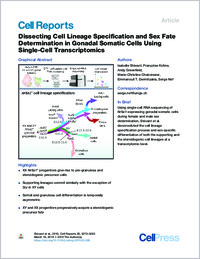
Dissecting Cell Lineage Specification and Sex Fate Determination in Gonadal Somatic Cells Using Single-Cell Transcriptomics.
- Stévant I Department of Genetic Medicine and Development, University of Geneva, 1211 Geneva, Switzerland; iGE3, Institute of Genetics and Genomics of Geneva, University of Geneva, 1211 Geneva, Switzerland; SIB, Swiss Institute of Bioinformatics, University of Geneva, 1211 Geneva, Switzerland.
- Kühne F Department of Genetic Medicine and Development, University of Geneva, 1211 Geneva, Switzerland.
- Greenfield A Mammalian Genetics Unit, Medical Research Council, Harwell Institute, Oxfordshire OX11 0RD, UK.
- Chaboissier MC Université Côte d'Azur, CNRS, Inserm, iBV, Nice, France.
- Dermitzakis ET Department of Genetic Medicine and Development, University of Geneva, 1211 Geneva, Switzerland; iGE3, Institute of Genetics and Genomics of Geneva, University of Geneva, 1211 Geneva, Switzerland; SIB, Swiss Institute of Bioinformatics, University of Geneva, 1211 Geneva, Switzerland.
- Nef S Department of Genetic Medicine and Development, University of Geneva, 1211 Geneva, Switzerland; iGE3, Institute of Genetics and Genomics of Geneva, University of Geneva, 1211 Geneva, Switzerland. Electronic address: serge.nef@unige.ch.
- 2019-03-21
Published in:
- Cell reports. - 2019
Sertoli cells
cell fate decision
differentiation
gene expression
gonad development
granulosa cell
lineage specification
ovary
progenitors
sex determination
single-cell RNA-seq
supporting cells
testis
transcriptomics
Animals
Cell Lineage
Female
Gene Expression Profiling
Granulosa Cells
Male
Mice
Mice, Transgenic
Sertoli Cells
Sex Determination Processes
Single-Cell Analysis
English
Sex determination is a unique process that allows the study of multipotent progenitors and their acquisition of sex-specific fates during differentiation of the gonad into a testis or an ovary. Using time series single-cell RNA sequencing (scRNA-seq) on ovarian Nr5a1-GFP+ somatic cells during sex determination, we identified a single population of early progenitors giving rise to both pre-granulosa cells and potential steroidogenic precursor cells. By comparing time series single-cell RNA sequencing of XX and XY somatic cells, we provide evidence that gonadal supporting cells are specified from these early progenitors by a non-sex-specific transcriptomic program before pre-granulosa and Sertoli cells acquire their sex-specific identity. In XX and XY steroidogenic precursors, similar transcriptomic profiles underlie the acquisition of cell fate but with XX cells exhibiting a relative delay. Our data provide an important resource, at single-cell resolution, for further interrogation of the molecular and cellular basis of mammalian sex determination.
- Language
-
- English
- Open access status
- gold
- Identifiers
-
- DOI 10.1016/j.celrep.2019.02.069
- PMID 30893600
- Persistent URL
- https://sonar.ch/global/documents/76648
Statistics
Document views: 54
File downloads:
- Full-text: 0