Ultra-sparse Connectivity within the Lateral Hypothalamus.
- Burdakov D Laboratory of Neurobehavioral Dynamics, Institute for Neuroscience, Department of Health Sciences and Technology, ETH Zürich, Zürich 8603, Switzerland; The Francis Crick Institute, London NW1 1AT, UK; Institute of Psychiatry, Psychology & Neuroscience, King's College London, London SE5 8AF, UK; Neuroscience Center Zürich (ZNZ), ETH Zürich and University of Zürich, Zürich 8057, Switzerland.
- Karnani MM Laboratory of Neurobehavioral Dynamics, Institute for Neuroscience, Department of Health Sciences and Technology, ETH Zürich, Zürich 8603, Switzerland; The Francis Crick Institute, London NW1 1AT, UK; Institute of Psychiatry, Psychology & Neuroscience, King's College London, London SE5 8AF, UK; Université de Paris, Saints-Pères Paris Institute for the Neurosciences (SPPIN), CNRS, Paris 75006, France. Electronic address: mahesh.karnani@parisdescartes.fr.
- 2020-08-22
Published in:
- Current biology : CB. - 2020
English
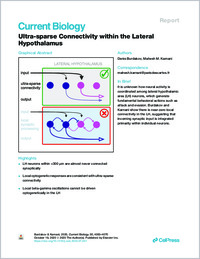
The lateral hypothalamic area (LH) is a vital controller of arousal, feeding, and metabolism [1, 2], which integrates external and internal sensory information. Whereas sensory and whole-body output properties of LH cell populations have received much interest, their intrinsic synaptic organization has remained largely unstudied. Local inhibitory and excitatory connections could help integrate and filter sensory information and mutually inhibitory connections [3] could allow coordinating activity between LH cell types, some of which have mutually exclusive behavioral effects, such as LH VGLUT2 and VGAT neurons [4-7] and orexin- (ORX) and melanin-concentrating hormone (MCH) neurons [8-10]. However, classical Golgi staining studies did not find interneurons with locally ramifying axons in the LH [11, 12], and nearby subthalamic and thalamic areas lack local synaptic connectivity [13, 14]. Studies with optogenetic circuit mapping within the LH have demonstrated only a minority of connections when a large pool of presynaptic neurons was activated [15-19]. Because multiple patch clamp has not been used to study LH connectivity, aside from a limited dataset of MCH neurons where no connections were discovered [15], we used quadruple whole-cell recordings to screen connectivity within the LH with standard methodology we previously used in the neocortex [20-22]. Finding a lack of local connectivity, we used optogenetic circuit mapping to study the strength of LH optogenetic responses and network oscillations, which were consistent with ultra-sparse intrinsic connectivity within the LH. These results suggest that input from other brain structures is decisive for selecting active populations in the LH.
- Language
-
- English
- Open access status
- hybrid
- Identifiers
-
- DOI 10.1016/j.cub.2020.07.061
- PMID 32822604
- Persistent URL
- https://sonar.ch/global/documents/77361
Export to…
Statistics
Document views: 74
File downloads:
- Full-text: 0