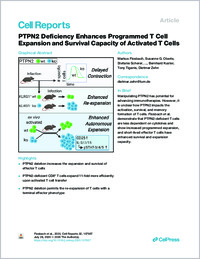
PTPN2 Deficiency Enhances Programmed T Cell Expansion and Survival Capacity of Activated T Cells.
- Flosbach M Division of Animal Physiology and Immunology, TUM School of Life Sciences Weihenstephan, Technical University of Munich (TUM), Freising, Germany.
- Oberle SG Division of Immunology and Allergy, Department of Medicine, Lausanne University Hospital, Lausanne, Switzerland.
- Scherer S Division of Animal Physiology and Immunology, TUM School of Life Sciences Weihenstephan, Technical University of Munich (TUM), Freising, Germany; Division of Immunology and Allergy, Department of Medicine, Lausanne University Hospital, Lausanne, Switzerland.
- Zecha J Chair of Proteomics and Bioanalytics, TUM School of Life Sciences Weihenstephan, Technical University of Munich (TUM), Freising, Germany.
- von Hoesslin M Division of Animal Physiology and Immunology, TUM School of Life Sciences Weihenstephan, Technical University of Munich (TUM), Freising, Germany.
- Wiede F Department of Biochemistry and Molecular Biology, Monash University, Clayton, VIC 3800, Australia; Peter MacCallum Cancer Centre, Melbourne, VIC 3000, Australia.
- Chennupati V Division of Immunology and Allergy, Department of Medicine, Lausanne University Hospital, Lausanne, Switzerland.
- Cullen JG Division of Animal Physiology and Immunology, TUM School of Life Sciences Weihenstephan, Technical University of Munich (TUM), Freising, Germany.
- List M Big Data in BioMedicine Group, Chair of Experimental Bioinformatics, TUM School of Life Sciences Weihenstephan, Technical University of Munich (TUM), Freising, Germany.
- Pauling JK ZD.B Junior Research Group LipiTUM, Chair of Experimental Bioinformatics, TUM School of Life Sciences Weihenstephan, Technical University of Munich (TUM), Freising, Germany.
- Baumbach J Chair of Experimental Bioinformatics, TUM School of Life Sciences Weihenstephan, Technical University of Munich (TUM), Freising, Germany.
- Kuster B Chair of Proteomics and Bioanalytics, TUM School of Life Sciences Weihenstephan, Technical University of Munich (TUM), Freising, Germany.
- Tiganis T Department of Biochemistry and Molecular Biology, Monash University, Clayton, VIC 3800, Australia; Peter MacCallum Cancer Centre, Melbourne, VIC 3000, Australia; Monash Biomedicine Discovery Institute, Monash University, Clayton, VIC 3800, Australia.
- Zehn D Division of Animal Physiology and Immunology, TUM School of Life Sciences Weihenstephan, Technical University of Munich (TUM), Freising, Germany; Division of Immunology and Allergy, Department of Medicine, Lausanne University Hospital, Lausanne, Switzerland. Electronic address: dietmar.zehn@tum.de.
- 2020-07-30
Published in:
- Cell reports. - 2020
GWAS
Protein tyrosine phosphatase non‑receptor type 2 (PTPN2)
T cell memory
adoptive T cell transfer
autoimmunity
effector T cells
immunotherapy
phosphoproteome
programmed T cell expansion
single point mutation
English
Manipulating molecules that impact T cell receptor (TCR) or cytokine signaling, such as the protein tyrosine phosphatase non-receptor type 2 (PTPN2), has significant potential for advancing T cell-based immunotherapies. Nonetheless, it remains unclear how PTPN2 impacts the activation, survival, and memory formation of T cells. We find that PTPN2 deficiency renders cells in vivo and in vitro less dependent on survival-promoting cytokines, such as interleukin (IL)-2 and IL-15. Remarkably, briefly ex vivo-activated PTPN2-deficient T cells accumulate in 3- to 11-fold higher numbers following transfer into unmanipulated, antigen-free mice. Moreover, the absence of PTPN2 augments the survival of short-lived effector T cells and allows them to robustly re-expand upon secondary challenge. Importantly, we find no evidence for impaired effector function or memory formation. Mechanistically, PTPN2 deficiency causes broad changes in the expression and phosphorylation of T cell expansion and survival-associated proteins. Altogether, our data underline the therapeutic potential of targeting PTPN2 in T cell-based therapies to augment the number and survival capacity of antigen-specific T cells.
- Language
-
- English
- Open access status
- gold
- Identifiers
-
- DOI 10.1016/j.celrep.2020.107957
- PMID 32726622
- Persistent URL
- https://sonar.ch/global/documents/806
Export to…
Statistics
Document views: 83
File downloads:
- Full-text: 0