The Alzheimer's Disease γ-Secretase Generates Higher 42:40 Ratios for β-Amyloid Than for p3 Peptides.
- Siegel G Systems and Cell Biology of Neurodegeneration, IREM, University of Zurich, Schlieren Campus, 8952 Schlieren, Switzerland. Electronic address: gabriele.siegel@irem.uzh.ch.
- Gerber H Foundation Eclosion, 1228 Plan-les-Ouates & Campus Biotech Innovation Park, 1202 Geneva, Switzerland; Brain Mind Institute and School of Life Sciences, Swiss Federal Institute of Technology (EPFL), 1015 Lausanne, Switzerland; Department of Biology, University of Fribourg, 1700 Fribourg, Switzerland.
- Koch P Institute of Reconstructive Neurobiology, University of Bonn Medical Faculty, 53127 Bonn, Germany; LIFE & BRAIN GmbH, 53127 Bonn, Germany.
- Bruestle O Institute of Reconstructive Neurobiology, University of Bonn Medical Faculty, 53127 Bonn, Germany; LIFE & BRAIN GmbH, 53127 Bonn, Germany.
- Fraering PC Foundation Eclosion, 1228 Plan-les-Ouates & Campus Biotech Innovation Park, 1202 Geneva, Switzerland; Brain Mind Institute and School of Life Sciences, Swiss Federal Institute of Technology (EPFL), 1015 Lausanne, Switzerland.
- Rajendran L Systems and Cell Biology of Neurodegeneration, IREM, University of Zurich, Schlieren Campus, 8952 Schlieren, Switzerland. Electronic address: rajendran@bli.uzh.ch.
- 2017-06-08
Published in:
- Cell reports. - 2017
AICD
APP CTF
Alzheimer’s disease
amyloid precursor protein
amyloidogenic pathway
beta-Amyloid
gamma-secretase
iPS cells
p3 peptide
primary neurons
Alzheimer Disease
Amyloid Precursor Protein Secretases
Amyloid beta-Peptides
Animals
Humans
Induced Pluripotent Stem Cells
Mice
Mice, Inbred ICR
Neurons
Peptide Fragments
English
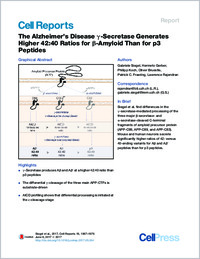
Alzheimer's disease is characterized by intracerebral deposition of β-amyloid (Aβ). While Aβ40 is the most abundant form, neurotoxicity is mainly mediated by Aβ42. Sequential cleavage of amyloid precursor protein (APP) by β- and γ-secretases gives rise to full-length Aβ (Aβ1-x) and N-terminally truncated Aβ' (Aβ11-x) whereas cleavage by α- and γ-secretases leads to the shorter p3 peptides (Aβ17-x). We uncovered significantly higher ratios of 42- versus 40-ending variants for Aβ and Aβ' than for p3 secreted by mouse neurons and human induced pluripotent stem cell (iPSC)-derived neurons or produced in a cell-free γ-secretase assay with recombinant APP-CTFs. The 42:40 ratio was highest for Aβ', followed by Aβ and then p3. Mass spectrometry analysis of APP intracellular domains revealed differential processing of APP-C83, APP-C89, and APP-C99 by γ-secretase already at the ε-cleavage stage. This mechanistic insight could aid in developing substrate-targeted modulators of APP-C99 processing to specifically lower the Aβ42:Aβ40 ratio without compromising γ-secretase function.
- Language
-
- English
- Open access status
- gold
- Identifiers
-
- DOI 10.1016/j.celrep.2017.05.034
- PMID 28591569
- Persistent URL
- https://sonar.ch/global/documents/88662
Statistics
Document views: 30
File downloads:
- Full-text: 0