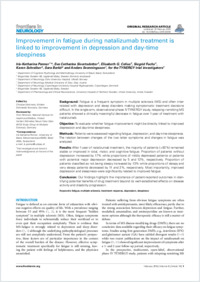
Improvement in Fatigue during Natalizumab Treatment is Linked to Improvement in Depression and Day-Time Sleepiness.
- Penner IK Department of Cognitive Psychology and Methodology, University of Basel , Basel , Switzerland.
- Sivertsdotter EC BiogenIdec Sweden AB , Upplands Väsby , Sweden (formerly employed).
- Celius EG Department of Neurology, Oslo University Hospital , Ullevål , Norway.
- Fuchs S Department of Neurology, Medical University of Graz , Graz , Austria.
- Schreiber K Department of Neurology, Copenhagen University Hospital Rigshospitalet , Copenhagen , Denmark.
- Berkö S BiogenIdec Sweden AB , Upplands Väsby , Sweden.
- Svenningsson A Department of Pharmacology and Clinical Neuroscience, University Hospital of Northern Sweden, Umeå University , Umeå , Sweden.
- 2015-03-11
Published in:
- Frontiers in neurology. - 2015
English
BACKGROUND
Fatigue is a frequent symptom in multiple sclerosis (MS) and often interrelated with depression and sleep disorders making symptomatic treatment decisions difficult. In the single-arm, observational phase IV TYNERGY study, relapsing-remitting MS patients showed a clinically meaningful decrease in fatigue over 1 year of treatment with natalizumab.
OBJECTIVE
To evaluate whether fatigue improvement might be directly linked to improved depression and day-time sleepiness.
METHODS
Patients were assessed regarding fatigue, depression, and day-time sleepiness. The relation between changes of the two latter symptoms and changes in fatigue was analyzed.
RESULTS
After 1 year of natalizumab treatment, the majority of patients (>92%) remained stable or improved in total, motor, and cognitive fatigue. Proportion of patients without depression increased by 17% while proportions of mildly depressed patients or patients with potential major depression decreased by 5 and 12%, respectively. Proportion of patients classified as not being sleepy increased by 13% while proportions of sleepy and very sleepy patients decreased by 11 and 2%, respectively. Most importantly, improved depression and sleepiness were significantly related to improved fatigue.
CONCLUSION
Our findings highlight the importance of patient-reported outcomes in identifying potential benefits of drug treatment beyond its well-established effects on disease activity and disability progression.
Fatigue is a frequent symptom in multiple sclerosis (MS) and often interrelated with depression and sleep disorders making symptomatic treatment decisions difficult. In the single-arm, observational phase IV TYNERGY study, relapsing-remitting MS patients showed a clinically meaningful decrease in fatigue over 1 year of treatment with natalizumab.
OBJECTIVE
To evaluate whether fatigue improvement might be directly linked to improved depression and day-time sleepiness.
METHODS
Patients were assessed regarding fatigue, depression, and day-time sleepiness. The relation between changes of the two latter symptoms and changes in fatigue was analyzed.
RESULTS
After 1 year of natalizumab treatment, the majority of patients (>92%) remained stable or improved in total, motor, and cognitive fatigue. Proportion of patients without depression increased by 17% while proportions of mildly depressed patients or patients with potential major depression decreased by 5 and 12%, respectively. Proportion of patients classified as not being sleepy increased by 13% while proportions of sleepy and very sleepy patients decreased by 11 and 2%, respectively. Most importantly, improved depression and sleepiness were significantly related to improved fatigue.
CONCLUSION
Our findings highlight the importance of patient-reported outcomes in identifying potential benefits of drug treatment beyond its well-established effects on disease activity and disability progression.
- Language
-
- English
- Open access status
- gold
- Identifiers
-
- DOI 10.3389/fneur.2015.00018
- PMID 25755648
- Persistent URL
- https://sonar.ch/global/documents/92848
Statistics
Document views: 27
File downloads:
- Full-text: 0