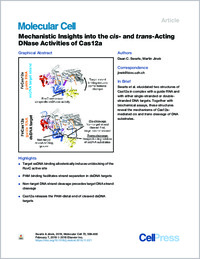
Mechanistic Insights into the cis- and trans-Acting DNase Activities of Cas12a.
- 2019-01-15
Published in:
- Molecular cell. - 2019
CRISPR-Cas
Cas12a
Cas9
Cpf1
DNA cleavage
DNase
PAM
genetic engineering
genome editing
ssDNase
Bacterial Proteins
CRISPR-Associated Proteins
CRISPR-Cas Systems
DNA, Single-Stranded
Enzyme Activation
Francisella
Gene Editing
Models, Molecular
Nucleic Acid Conformation
Protein Conformation
RNA, Guide
Structure-Activity Relationship
Substrate Specificity
English
CRISPR-Cas12a (Cpf1) is an RNA-guided DNA-cutting nuclease that has been repurposed for genome editing. Upon target DNA binding, Cas12a cleaves both the target DNA in cis and non-target single-stranded DNAs (ssDNAs) in trans. To elucidate the molecular basis for both DNase cleavage modes, we performed structural and biochemical studies on Francisella novicida Cas12a. We show that guide RNA-target strand DNA hybridization conformationally activates Cas12a, triggering its trans-acting, non-specific, single-stranded DNase activity. In turn, cis cleavage of double-stranded DNA targets is a result of protospacer adjacent motif (PAM)-dependent DNA duplex unwinding, electrostatic stabilization of the displaced non-target DNA strand, and ordered sequential cleavage of the non-target and target DNA strands. Cas12a releases the PAM-distal DNA cleavage product and remains bound to the PAM-proximal DNA cleavage product in a catalytically competent, trans-active state. Together, these results provide a revised model for the molecular mechanisms of both the cis- and the trans-acting DNase activities of Cas12a enzymes, enabling their further exploitation as genome editing tools.
- Language
-
- English
- Open access status
- bronze
- Identifiers
-
- DOI 10.1016/j.molcel.2018.11.021
- PMID 30639240
- Persistent URL
- https://sonar.ch/global/documents/94436
Statistics
Document views: 53
File downloads:
- Full-text: 0