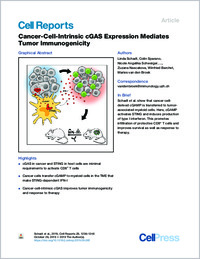
Cancer-Cell-Intrinsic cGAS Expression Mediates Tumor Immunogenicity.
- Schadt L Institute of Experimental Immunology, University of Zurich, Winterthurerstrasse 190, 8057 Zurich, Switzerland.
- Sparano C Institute of Experimental Immunology, University of Zurich, Winterthurerstrasse 190, 8057 Zurich, Switzerland.
- Schweiger NA Institute of Experimental Immunology, University of Zurich, Winterthurerstrasse 190, 8057 Zurich, Switzerland.
- Silina K Institute of Experimental Immunology, University of Zurich, Winterthurerstrasse 190, 8057 Zurich, Switzerland.
- Cecconi V Institute of Experimental Immunology, University of Zurich, Winterthurerstrasse 190, 8057 Zurich, Switzerland.
- Lucchiari G Institute of Experimental Immunology, University of Zurich, Winterthurerstrasse 190, 8057 Zurich, Switzerland.
- Yagita H Department of Immunology, Juntendo University School of Medicine, Tokyo 113-8421, Japan.
- Guggisberg E Institute of Experimental Immunology, University of Zurich, Winterthurerstrasse 190, 8057 Zurich, Switzerland.
- Saba S Institute of Experimental Immunology, University of Zurich, Winterthurerstrasse 190, 8057 Zurich, Switzerland.
- Nascakova Z Institute of Molecular Genetics of the ASCR, v. v. i., Videnska 1083, 142 20 Prague, Czech Republic.
- Barchet W Institute of Clinical Chemistry and Clinical Pharmacology, University Hospital and University of Bonn, Sigmund-Freud-Strasse 25, 35127 Bonn, Germany.
- van den Broek M Institute of Experimental Immunology, University of Zurich, Winterthurerstrasse 190, 8057 Zurich, Switzerland. Electronic address: vandenbroek@immunology.uzh.ch.
- 2019-10-31
Published in:
- Cell reports. - 2019
CD8(+) T cells
STING
cGAMP
cGAS
cancer
chemotherapy
gap junctions
immunotherapy
radiotherapy
type I IFN
Animals
CD8-Positive T-Lymphocytes
Cell Line, Tumor
DNA Damage
Dendritic Cells
Disease Progression
Humans
Immunotherapy
Interferon Type I
Membrane Proteins
Mice, Inbred C57BL
Microsatellite Repeats
Neoplasms
Nucleotides, Cyclic
Nucleotidyltransferases
English
Sensing of cytoplasmic DNA by cyclic guanosine monophosphate-adenosine monophosphate (cGAMP) synthase (cGAS) results in production of the dinucleotide cGAMP and consecutive activation of stimulator of interferon genes (STING) followed by production of type I interferon (IFN). Although cancer cells contain supra-normal concentrations of cytoplasmic DNA, they rarely produce type I IFN spontaneously. This suggests that defects in the DNA-sensing pathway may serve as an immune escape mechanism. We find that cancer cells produce cGAMP that is transferred via gap junctions to tumor-associated dendritic cells (DCs) and macrophages, which respond by producing type I IFN in situ. Cancer-cell-intrinsic expression of cGAS, but not STING, promotes infiltration by effector CD8+ T cells and consequently results in prolonged survival. Furthermore, cGAS-expressing cancers respond better to genotoxic treatments and immunotherapy. Thus, cancer-cell-derived cGAMP is crucial to protective anti-tumor CD8+ T cell immunity. Consequently, cancer-cell-intrinsic expression of cGAS determines tumor immunogenicity and makes tumors hot. These findings are relevant for genotoxic and immune therapies for cancer.
- Language
-
- English
- Open access status
- gold
- Identifiers
-
- DOI 10.1016/j.celrep.2019.09.065
- PMID 31665636
- Persistent URL
- https://sonar.ch/global/documents/95615
Statistics
Document views: 95
File downloads:
- Full-text: 0